New articles every week — Expert-backed health & beauty tips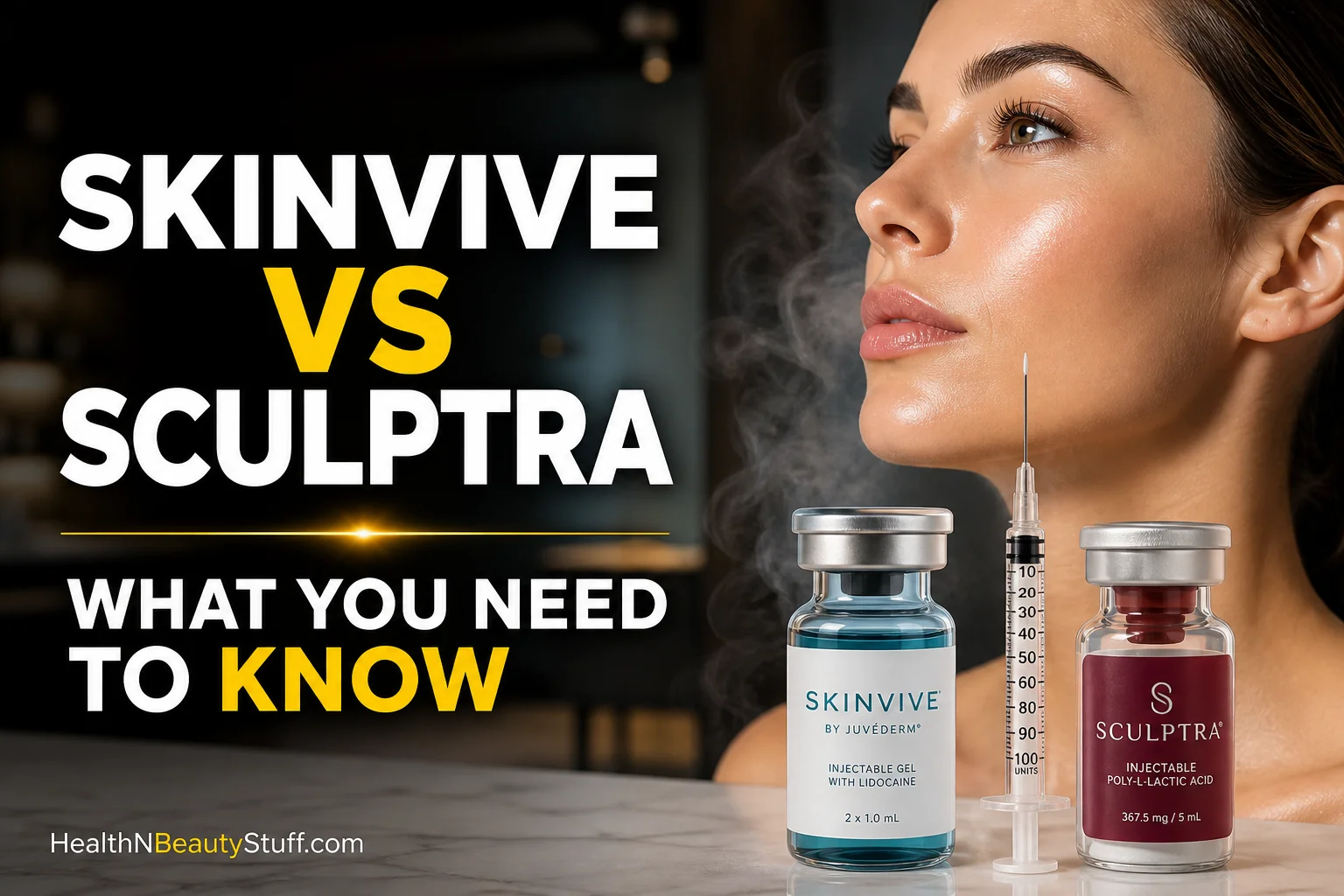
Picture two friends in the same med-spa waiting room. Mara wants her tired skin to look smoother and more hydrated. Dana wants her flat-looking cheeks to regain some shape.
They share the same fear: spending thousands, looking overfilled, or ending up with lumps. Yet they need very different treatments.
Skinvive and Sculptra are not interchangeable. Skinvive improves surface hydration and smoothness. Sculptra stimulates collagen to restore gradual facial structure. The key question is which one fits your face.
Quick Verdict: Choose Skinvive for dull, dehydrated skin when you want a subtle refresh. Choose Sculptra for facial hollowing when you want gradual, longer-lasting volume. Consider both if you need deeper support and better surface texture.
Skinvive vs Sculptra at a glance
Skinvive treats skin quality, while Sculptra treats gradual volume loss. This distinction should guide most of your decision.
| Feature | Skinvive | Sculptra |
|---|---|---|
| Product type | Hyaluronic acid injectable | Poly-L-lactic acid collagen stimulator |
| Main purpose | Improve cheek smoothness and hydration | Restore facial volume gradually |
| Best suited to | Dull, rough, dehydrated-looking cheek skin | Hollow cheeks, temples, and facial volume loss |
| Visible change | Develops during the first few weeks | Develops gradually over several months |
| Treatment plan | Usually one initial treatment, based on provider assessment | Commonly given as a series of treatments |
| Duration | Improvement may last about six months | Results may last up to two years |
| Reversibility | Its HA component may be treated with hyaluronidase, although correction is not guaranteed | Cannot be dissolved like an HA filler |
| Common concerns | Redness, swelling, bruising, tenderness, and small bumps | Swelling, bruising, tenderness, and delayed lumps or nodules |
| Typical pricing method | Priced by syringe or treatment area | Priced by vial and total treatment series |
What is Skinvive? (And what it is not)
Skinvive is a hyaluronic acid skin-quality injectable, not a traditional volumizing filler. Its full brand name is Juvéderm Skinvive, and Allergan Aesthetics makes it.
Hyaluronic acid, or HA, is a water-binding substance found naturally in the body. In Skinvive, small amounts of HA gel are injected across the cheeks.
The goal is smoother, more hydrated-looking skin. Think of it as a moisture-focused treatment working beneath the surface.
Skinvive is not designed to build cheekbones or lift loose skin. It will not replace lost facial structure. It also will not correct deep folds the way a traditional filler might.
It may fit your goals if you notice:
- Crepey or rough-looking cheek skin
- Dullness that persists despite good skincare
- Fine texture changes
- Dehydrated-looking skin without major hollowing
- A desire for subtle improvement rather than added fullness
The US Food and Drug Administration approved Skinvive for improving cheek skin smoothness in adults over 21. That specific approval matters. Marketing terms such as “full-face glow” may go beyond the studied use.
What is Sculptra? (And how it works)
Sculptra is a collagen-stimulating injectable that gradually restores facial volume. Galderma makes it, and its main ingredient is poly-L-lactic acid, or PLLA.
That name sounds technical. In plain language, PLLA is a biodegradable material that encourages your body to make collagen.
Collagen acts like internal support for your skin. As your body produces more of it, treated areas may look firmer and less hollow.
Sculptra does not provide its final result on injection day. Early fullness is largely related to the water used during treatment and temporary swelling. That fades before collagen develops.
Many clinics call the later improvement a “Sculptra glow.” This is an informal marketing phrase, not a defined medical outcome.
Sculptra may be considered for:
- Cheek or midface hollowing
- Temple volume loss
- Age-related facial deflation
- Gradual improvement without a sudden filled look
- People willing to complete a treatment series
It is not ideal for every facial area. Placement, dilution, and injection technique require detailed anatomical knowledge.
Skinvive vs Sculptra: How do they work differently?
Skinvive adds water-binding HA to the skin, while Sculptra stimulates new collagen support. One works mainly on skin quality. The other targets deeper structural change.
Imagine Skinvive as an injectable hydrating serum. It spreads tiny deposits of HA through the treated skin to improve smoothness.
Sculptra is more like internal strength training for collagen. The treatment starts a slow rebuilding process rather than supplying ready-made volume.
A simple clinic analogy is:
- Sculptra is the foundation: It supports gradual structure and volume.
- Skinvive is the topcoat: It improves hydration and surface smoothness.
This analogy has limits. Neither product repairs every sign of aging, and neither can replace surgery when significant tissue sagging is present.
Still unsure which problem you have? Look at your face in even daylight. If it appears hollow from the side, structure may be the issue. If the shape looks good but the cheeks seem dull or crepey, skin quality may be the bigger concern.
Sculptra vs Skinvive: Results timeline
Skinvive works faster, while Sculptra asks for patience. Skinvive improvement appears during the first few weeks. Sculptra develops over several months as collagen forms.
| Time | Skinvive | Sculptra |
|---|---|---|
| First 24 to 72 hours | Swelling, redness, tenderness, or small raised spots may be visible | Temporary swelling can resemble added volume |
| First two weeks | Injection effects settle and smoothness may begin improving | Early water-related fullness fades, so the face may look closer to baseline |
| First month | The cheek skin may look smoother and more hydrated | Collagen-related change may begin, but it can remain subtle |
| Two to six months | Benefits continue but gradually decline toward retreatment | Volume and contour develop as the treatment series takes effect |
| Six months and beyond | Many patients discuss maintenance treatment | Results may remain visible for up to two years |
Gradual change is not always a drawback. Some people prefer that friends notice they look rested without spotting an obvious procedure.
If you have a wedding next month, however, Sculptra is a poor last-minute choice. Allow time for treatment planning, healing, and delayed collagen production.
Skinvive cost vs Sculptra cost: Real-world budgeting
Sculptra usually requires the larger upfront budget. Skinvive often involves fewer units at one visit, while Sculptra is commonly priced by vial across a treatment series.
There is no reliable national price that predicts your personal quote. Costs vary by location, provider experience, facial anatomy, and the amount used.
Published US clinic prices commonly place Skinvive at roughly $650 to $1,000 per treatment. Sculptra often costs about $800 to $1,200 per vial, with total series costs commonly reaching $2,000 to $4,000 or more.
These are market estimates, not fixed fees. Cosmetic injections are generally paid out of pocket.
Compare total cost, not one appointment. Skinvive may cost less today but need maintenance around six months. Sculptra costs more initially but may provide improvement for up to two years.
Before paying a deposit, ask for:
- The price per Skinvive syringe
- The price per Sculptra vial
- The expected number of syringes or vials
- The complete cost of a Sculptra series
- Fees for follow-ups or touch-ups
- The clinic’s policy if treatment must stop
Be cautious with unusually cheap packages. Injectable treatment is not the place to choose by price alone. Product sourcing and provider training matter.
Recovery and side effects: What patients actually feel
Both treatments can cause swelling, bruising, and tenderness. Most reactions are temporary, but Sculptra adds concern about delayed lumps and cannot be dissolved like HA.
After Skinvive
The cheeks may feel tender or look puffy after treatment. Tiny injection bumps can also appear before the product settles.
Common reported effects include:
- Redness at injection points
- Swelling or firmness
- Tenderness and mild pain
- Bruising
- Itching or discoloration
- Small lumps or bumps
Most routine reactions improve without major downtime. Still, avoid scheduling injections immediately before an important event. Bruises do not follow your calendar.
After Sculptra
Swelling may make the result look impressive at first. That early fullness decreases as the injected water is absorbed.
Possible effects include:
- Swelling and soreness
- Bruising or redness
- Bleeding at injection points
- Small bumps under the skin
- Delayed nodules that may be visible or felt
Yes, Sculptra can cause lumps or nodules. Some resolve with time or treatment. Others can persist and need assessment by an experienced medical provider.
Massage instructions may be given after Sculptra. Follow your injector’s directions rather than advice from social media. Instructions can vary with technique and your medical needs.
Can either injectable be reversed?
Skinvive offers more correction options because it contains HA. Hyaluronidase is an enzyme used by clinicians to break down hyaluronic acid.
Dissolving is still a medical procedure. It can require more than one treatment and may not produce a perfect reset.
Sculptra cannot be directly dissolved. Management may involve observation, massage, medication, or treatment of a nodule by a qualified clinician.
Seek urgent care for severe pain, pale or blotchy skin, vision changes, weakness, or stroke-like symptoms after any filler injection. Rare blood-vessel blockage can cause serious harm.
Who is the best candidate for each?
The best choice depends on anatomy, not age. Skinvive fits poor surface quality. Sculptra fits gradual loss of deeper support.
The Glow Seeker
You have good cheek shape, but your skin looks tired. Makeup catches on rough patches. Another moisturizer has not made enough difference.
Skinvive may match this goal. It can improve cheek smoothness without intentionally creating prominent volume.
Set realistic expectations. The effect is subtle and temporary. If you expect lifted cheeks, you may feel that you wasted money.
The Volume Rebuilder
Your cheeks or temples look flatter than they did years ago. Photos show shadows that skincare cannot fix.
Sculptra may better address this structural change. It suits someone who values gradual improvement and can return for multiple visits.
It will not create the instant precision of traditional HA filler. Patience is part of the treatment.
The Skeptical First-Timer
You fear looking “done.” You also worry about lumps and whether the product can be removed.
Risk tolerance should influence your choice. Skinvive acts more superficially and contains dissolvable HA. Sculptra has delayed results and no simple reversal method.
A conservative plan may mean starting with no treatment. A second consultation with a board-certified dermatologist or plastic surgeon can clarify your anatomy and options.
Can you combine Skinvive and Sculptra?
Yes, Skinvive and Sculptra may be combined in a staged plan. They address different tissue needs, so using both can make sense.
A practical treatment sequence may look like this:
- Step one: Assess volume loss, skin quality, movement, and facial proportions.
- Step two: Complete the planned Sculptra series for deeper collagen support.
- Step three: Allow swelling to settle and assess the developing result.
- Step four: Add Skinvive if cheek texture and hydration still need attention.
This is a rationale, not a fixed schedule. Some providers may treat during the same period. Others prefer more separation so they can judge each product’s effect.
Ask for a written sequence before committing. It should explain what comes first, how results will be assessed, and what the entire plan costs.
When to choose neither (or something else)
Neither injectable is automatically the best answer. Another treatment may offer greater control, faster change, or a better match for your concern.
Consider other options when:
- You want immediate, precise volume in one area
- Your main concern is significant loose skin
- You cannot complete follow-up visits
- You want a treatment that can be reversed
- Your budget does not support maintenance
- Your expectations exceed what injections can achieve
Traditional HA filler can provide immediate, targeted volume. It may suit lips, folds, cheeks, or specific contour changes, depending on the product and anatomy.
Radiesse contains calcium hydroxylapatite. It offers some immediate correction and also stimulates collagen. Like Sculptra, it is not dissolved with hyaluronidase.
Fat grafting uses your own fat for larger or longer-term volume correction. It is a surgical procedure with more recovery and less predictable fat survival.
For surface concerns, options include:
- Microneedling for texture and collagen support
- Chemical peels for selected pigment and surface issues
- Prescription retinoids for fine lines and uneven texture
- Daily sunscreen to prevent further damage
- Topical HA products for temporary surface hydration
Topical HA cannot copy an injectable result. Still, it is cheaper, painless, and a reasonable starting point for mild dryness.
Delay treatment if you have an active skin infection near the injection area. Discuss allergies, immune conditions, bleeding problems, medicines, and past fillers during your consultation.
Safety during pregnancy or breastfeeding has not been established for these cosmetic treatments. Most providers recommend waiting.
Permanent fillers or unknown products require special caution. Bring old treatment records if possible. Injecting into altered tissue can complicate planning.
Skinvive vs Sculptra: Which is better?
Skinvive is better for hydration and smoothness, while Sculptra is better for gradual volume restoration. Neither is the universal winner.
Choose Skinvive if:
- You want a subtle cheek-skin refresh
- Your facial structure is already satisfactory
- You prefer a faster visible change
- You accept maintenance around every six months
- Having an HA-based treatment lowers your anxiety
Choose Sculptra if:
- You have noticeable facial hollowing
- You want gradual, natural-looking change
- You can wait several months for the result
- You can budget for a treatment series
- You accept that it cannot be dissolved
Choose both if:
- You have volume loss and poor cheek texture
- Your provider recommends a staged approach
- You understand each product’s separate role
- The complete plan fits your budget
Return to three deciding factors: your main concern, your timeline, and your comfort with risk. A good injector should explain all three without pressuring you.
Look for a licensed medical provider with specific experience using both products. Ask to see results on faces with concerns similar to yours, not just their most dramatic photos.