New articles every week — Expert-backed health & beauty tips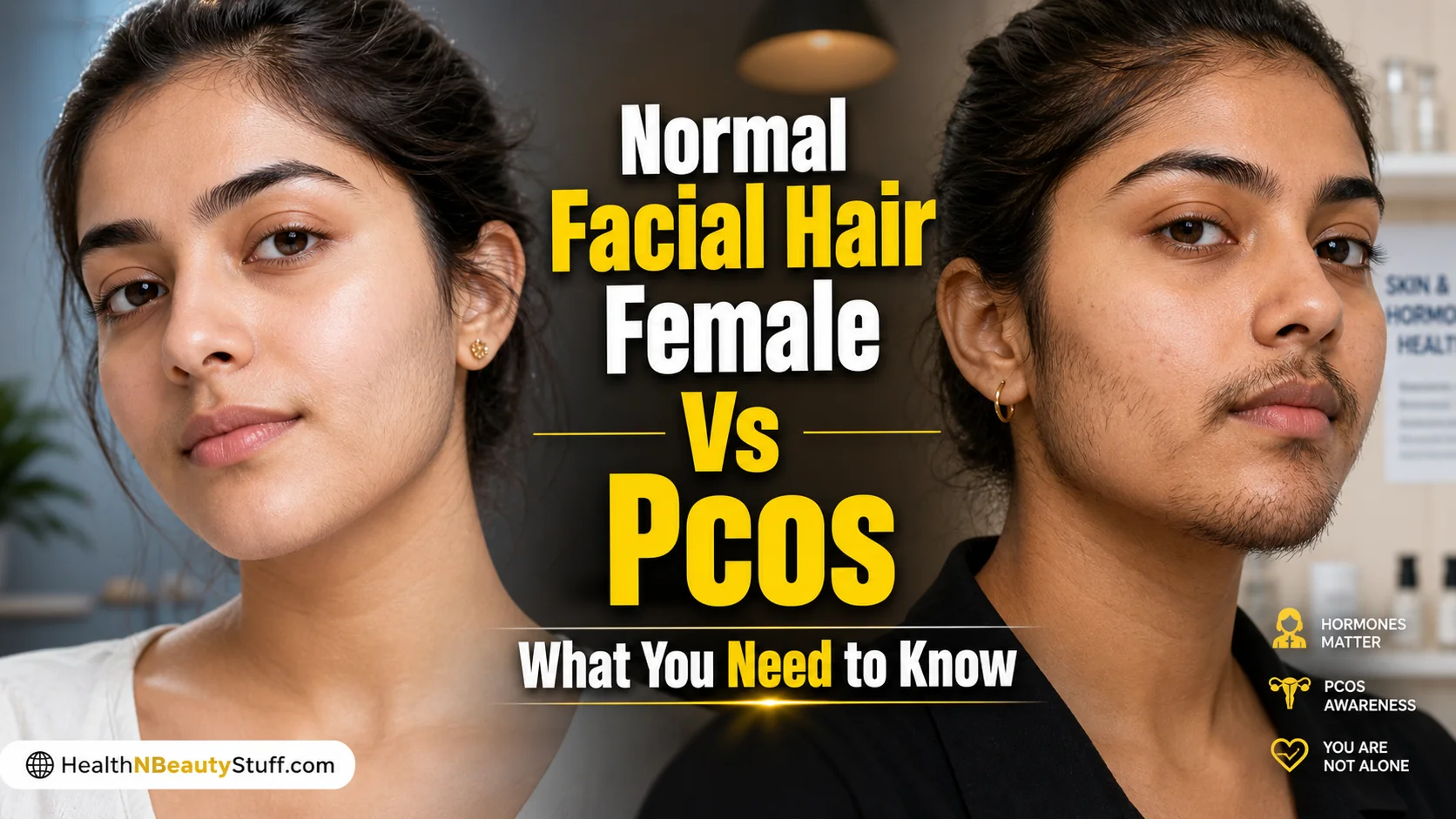
You catch your face in the car mirror and spot a dark chin hair. You are sure it was not there last week. You pluck it, then pause. Is this normal, or could it be PCOS?
That question can feel scary, especially if more hairs keep appearing. Normal facial hair is usually fine, soft, and evenly spread. PCOS facial hair tends to be coarse, dark, and beard-like. It often appears with irregular periods, acne, or scalp hair thinning.
Quick Verdict: Most women have some normal facial hair. PCOS is more likely when coarse, dark hair grows on the chin, upper lip, sideburns, neck, chest, or lower stomach and other hormone-related symptoms are present. Only a clinician can confirm PCOS through your history, an exam, and appropriate tests.
Most female facial hair is normal: this is what it looks like
Fine, soft, stable facial hair is usually a normal body feature. Almost every woman has hair across her cheeks, upper lip, jaw, and chin. It may be hard to see, or it may look darker under bright light.
This soft hair is called vellus hair, or “peach fuzz”. It is usually thin and short. Terminal hair is different. It is thicker, longer, and more strongly colored, like eyebrow or scalp hair.
A few terminal chin hairs can also be normal. They often appear with age and changing hormones. One or two new hairs do not prove that you have polycystic ovary syndrome, or PCOS.
Normal facial hair often has these features:
- It is fine, soft, or lightly colored.
- It appears evenly on both sides of the face.
- It has changed slowly over several years.
- Your close relatives have a similar hair pattern.
- Your periods are regular for you.
- You have no major acne or scalp hair loss.
Genetics and ancestry strongly affect visible hair. Women with Mediterranean, Middle Eastern, South Asian, or African ancestry may naturally have darker facial and body hair. Dark hair alone does not mean the growth is abnormal.
The better question is not, “Can I see hair?” Ask whether its texture, location, or growth rate has changed.
PCOS facial hair is coarse, dark, and male-pattern: not just extra peach fuzz
PCOS facial hair usually involves thick terminal hairs in a male-pattern distribution. Doctors call this hirsutism. It is different from having visible but soft peach fuzz.
Common locations include:
- The upper lip and chin
- The jaw, sideburns, and neck
- The center of the chest
- The lower stomach
- The back or inner thighs
PCOS can raise androgen activity. Androgens are hormones that all women produce. Higher levels, or greater follicle sensitivity to them, can turn fine hairs into coarse terminal hairs.
The growth may start slowly. You might first pluck one chin hair each month, then notice several every week. Hair can also become darker, thicker, or spread into new areas.
Facial hair alone is not enough to diagnose PCOS. Hirsutism becomes more suggestive when it appears with other signs, such as:
- Periods that are widely spaced, unpredictable, or absent
- Persistent acne, especially around the jaw
- Thinning hair near the scalp part or crown
- Problems with ovulation or fertility
- Dark, velvety skin patches
- Weight changes or signs of insulin resistance
Some women with PCOS have regular-looking cycles. Others have little facial hair. PCOS does not look the same in every person.
Normal facial hair vs PCOS facial hair: distribution and texture are the fastest clues
Hair pattern and texture tell you more than the total hair count. Soft cheek hair can be very visible without being hirsutism. A smaller number of coarse chin or chest hairs may deserve closer attention.
| Comparison item | Normal female facial hair | PCOS-related facial hair |
|---|---|---|
| Hair type | Fine, soft vellus hair, sometimes with a few coarse strands | Thick, dark, coarse terminal hair |
| Common areas | Cheeks, upper lip, sides of the face, and chin | Chin, upper lip, sideburns, neck, chest, and lower stomach |
| Pattern | Even or similar on both sides | Beard-like or male-pattern growth |
| Onset | Present for years or increasing slowly with age | May appear around puberty or worsen over time |
| Growth | Usually stable or slow | May return soon after shaving or plucking |
| Other signs | Often none | Irregular periods, acne, or scalp hair thinning |
| Usual response | Leave it alone or remove it cosmetically | Medical assessment plus optional hair removal |
Do you need to pluck dark hairs every day or every week? That observation is worth sharing with a doctor. Still, plucking frequency is a clue, not a diagnosis. Hair removal habits and natural growth rates differ.
Take clear photos every few months if you are unsure about progression. Track the locations rather than counting every strand. This gives your clinician more useful information.
You may need PCOS testing if you have 2 or more of these signs
Two or more hormone-related signs make a medical assessment reasonable. This is not a diagnosis rule. It is a practical signal to stop guessing and discuss your symptoms with a clinician.
- Irregular cycles: Periods are often missed, widely spaced, or hard to predict.
- Male-pattern facial hair: Coarse hairs grow on the chin, upper lip, jaw, or neck.
- Persistent acne: Breakouts are moderate, severe, or concentrated near the jaw.
- Scalp hair thinning: Your part looks wider, or the crown is becoming less dense.
- Dark skin patches: Velvety areas appear around the neck, groin, or underarms.
- Weight or metabolic changes: You have unexplained gain or signs of insulin resistance.
- Family history: A parent or sibling has PCOS or type 2 diabetes.
Cycle tracking can help. Record bleeding dates, acne changes, hair growth, medications, and recent weight changes. Bring that record to your appointment.
Sudden or rapidly worsening hair growth needs prompt evaluation. Seek care if coarse hair appears over months rather than years. A deeper voice, new muscle growth, or other rapid body changes also need medical attention.
These changes usually do not mean cancer. Rare ovarian or adrenal causes are possible, though, so sudden severe symptoms should not be ignored.
PCOS facial hair vs normal facial hair: the diagnostic tests
PCOS is diagnosed from a combination of symptoms, examination findings, and tests. No single facial hair, blood result, or ultrasound image can settle the question by itself.
A clinician may begin by asking about:
- Your menstrual cycle and age when symptoms began
- How quickly the hair appeared or spread
- Acne, scalp hair loss, and weight changes
- Medicines, supplements, and family history
- Pregnancy plans and past fertility concerns
The Modified Ferriman-Gallwey score may be used during the exam. It rates terminal hair in several androgen-sensitive body areas. The score estimates the overall pattern of hirsutism, but cutoffs can vary with ancestry and clinical guidance.
Blood testing may include total or free testosterone and DHEA-S. A clinician may also consider 17-hydroxyprogesterone, prolactin, thyroid tests, or other labs based on your symptoms.
A pelvic ultrasound can look at the ovaries. Yet an ultrasound is not always required for diagnosis. Some women without PCOS have polycystic-looking ovaries, while some women with PCOS do not.
Common diagnostic guidelines consider three main features:
- Irregular or absent ovulation
- Clinical or laboratory signs of androgen excess
- Polycystic ovarian appearance on ultrasound
Other possible causes must first be considered. This matters even when the hair is mild. A correct diagnosis guides cycle care, fertility planning, metabolic screening, and treatment.
Treatment: manage hormones first, then add hair removal
The best long-term plan treats any hormone driver and the visible hair together. Cosmetic treatment removes or slows hair. It does not diagnose PCOS or correct irregular ovulation.
Depending on your health and pregnancy plans, medical options may include:
- Combined birth control pills: These may regulate cycles and reduce androgen effects.
- Progestin treatment: This can protect the uterine lining when periods are infrequent.
- Spironolactone: This off-label anti-androgen may reduce new coarse hair growth over time.
- Eflornithine cream: This prescription treatment slows facial hair growth but does not remove existing hair.
Spironolactone is not appropriate during pregnancy. It often requires reliable contraception and medical monitoring. Ask your prescriber about personal risks and follow-up needs.
Hormone treatments work slowly because hair grows in cycles. Existing terminal hairs may remain even after androgen activity improves. Several months may pass before growth becomes slower or finer.
Hair removal choices include:
- Shaving or trimming: Fast and safe when done gently. Shaving does not make hair grow back thicker.
- Waxing or threading: Removes hair from the root but may irritate sensitive skin.
- Laser hair removal: Usually works best on dark, coarse hair and needs multiple sessions.
- Electrolysis: Treats individual follicles and can suit light, red, white, or gray hair.
Laser can still help when you have PCOS. However, active androgen excess may drive new hair growth. Maintenance sessions are often needed.
Starting laser before addressing PCOS hormones is like doing the cosmetic crown before the root canal. The visible result may improve, but the underlying problem remains active.
Pros and cons: testing and treating PCOS facial hair vs treating it cosmetically
Your symptoms and goals should decide the approach. There is no need to medicalize stable facial hair with no other warning signs. There is also no need to delay cosmetic relief while completing a workup.
Get a PCOS workup first
- Pros: Identifies possible hormone causes and guides cycle or metabolic care.
- Cons: May involve blood tests, an exam, imaging, and more than one visit.
- Best fit: Irregular periods, spreading coarse hair, acne, or scalp thinning.
Start cosmetic hair removal
- Pros: Provides visible improvement without waiting for a diagnosis.
- Cons: Regrowth may continue if elevated androgen activity remains untreated.
- Best fit: Stable hair with regular cycles and no other concerning symptoms.
Combine medical and cosmetic care
- Pros: Addresses new growth while removing existing terminal hairs.
- Cons: Requires follow-up, patience, and several forms of care.
- Best fit: Confirmed PCOS or another ongoing hormone cause.
Do nothing and monitor
- Pros: Avoids unwanted treatment for a normal body feature.
- Cons: New symptoms could be missed without occasional reassessment.
- Best fit: Fine, stable hair with no cycle changes or androgen-related signs.
Facial hair does not make you unhealthy, unclean, or less feminine. Treatment is optional unless an underlying condition needs care. Your comfort matters, but appearance is not a medical emergency.
It depends: age, ethnicity, and hormone status
What is normal depends partly on your baseline, age, ancestry, and medicines. A pattern that is new for you matters more than whether it matches someone else’s face.
Age and perimenopause
New chin hairs around age 45 may come from perimenopause rather than PCOS. Estrogen falls during this transition. Androgen effects can become more noticeable, even when androgen levels are not unusually high.
A few gradual hairs are common. Rapid spreading growth or other major body changes still deserve an assessment.
Ethnicity and family pattern
Some families naturally have more visible terminal hair. Dark hair with regular cycles and no other symptoms may be normal for you. Clinicians should consider ancestry when interpreting hair scores.
Medicines and other conditions
Danazol, anabolic steroids, testosterone exposure, and some other medicines can increase hair growth. Do not stop a prescribed drug on your own. Ask whether it could explain the timing.
Non-PCOS causes include thyroid disorders, non-classic congenital adrenal hyperplasia, and Cushing’s syndrome. Menopause and other ovarian or adrenal conditions can also play a role.
If PCOS tests are negative but hirsutism is severe, keep looking with your clinician. Negative PCOS testing does not mean your symptoms are imaginary.
Normal facial hair female vs PCOS: the honest answer
The strongest clues are coarse texture, male-pattern distribution, fast progression, and companion symptoms. The amount of hair alone is less useful.
If your hair is fine, light, stable, and your cycles are normal, you can remove it or leave it alone. Both choices are valid.
If it is dark, coarse, spreading, or paired with irregular periods, acne, or scalp thinning, book an assessment. PCOS is treatable, and it is not too late to ask for help.
Describe the pattern, timing, and cycle changes clearly. Bring photos or a symptom log if needed. You deserve a careful medical review without shame or dismissal.