New articles every week — Expert-backed health & beauty tips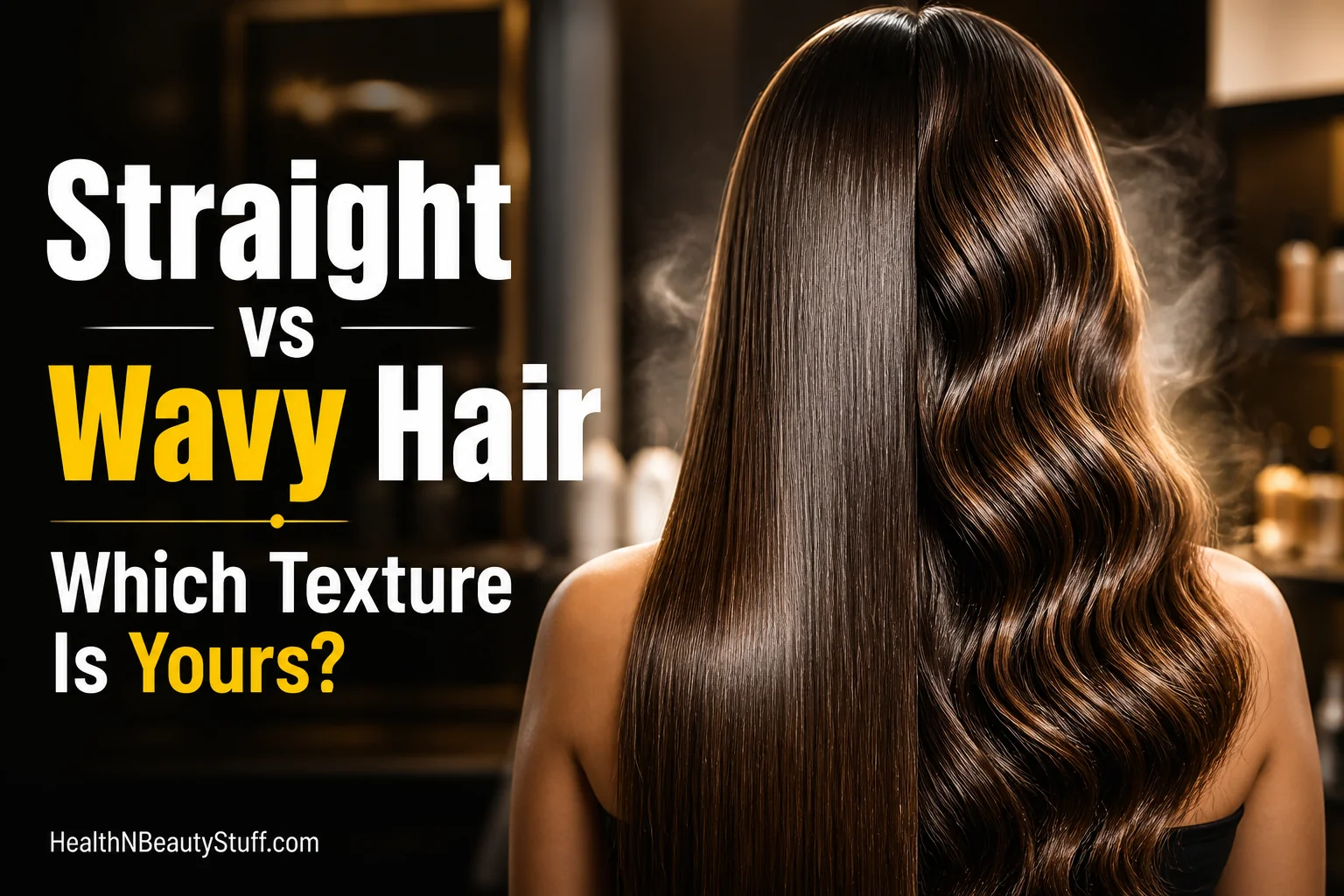
Straight vs Wavy Hair: Which Texture Is Really Yours?
You catch your reflection after letting your hair air-dry. The top looks almost straight, but the ends flip out. Underneath, there are soft bends and a cloud of frizz. What if your “straight” hair is not actually straight?
There is no universal winner between straight and wavy hair. The best choice depends on your natural texture, styling time, and comfort with heat damage. That question matters when your hair never seems to behave as expected.
Straight hair looks sleek with less product. Wavy hair offers natural volume and movement. But forcing either texture into the other every day takes work. It can also leave hair dry, dull, and fragile.
Quick Verdict: Straight hair is smooth and easy to polish. Wavy hair has more texture and volume. If your hair is naturally wavy, daily straightening creates the greatest damage risk. If it is naturally straight, frequent high-heat curling creates the same problem. The healthiest option is usually to work with your natural texture.
At-a-Glance: Straight vs Wavy Hair Comparison Table
Straight hair favors sleekness, while wavy hair favors volume and movement. Here is how the two textures compare in daily life.
| Comparison Point | Straight Hair | Wavy Hair |
|---|---|---|
| Natural shape | No lasting S-shaped bends; falls flat from roots to ends | Loose S-shaped bends through some or all of the hair |
| Humidity behavior | May become flat, limp, or oily-looking | May expand, lose definition, or become frizzy |
| Daily maintenance | Fewer styling products; may need dry shampoo or root lift | Often needs mousse, gel, or styling cream for definition |
| Changing the texture | Needs braiding, rollers, or a curling tool to create waves | Needs careful blow-drying or flat-ironing for a sleek finish |
| Best visual effect | Smooth, polished, and uniform | Full, textured, and naturally dimensional |
What Actually Defines Straight vs Wavy Hair?
Straight hair has no lasting wave pattern, while wavy hair forms visible S-shaped curves. These labels describe appearance. They are not medical diagnoses.
Type 1 is the common beauty-industry label for straight hair. Type 2 describes wavy hair. Within those groups, texture can range from fine and soft to coarse and thick.
Hair can also have more than one pattern. The top layer may look straight while hidden sections form waves. Length, brushing, damage, and heavy products can stretch those waves.
Pros of straight hair
- It often looks smooth and shiny with little product.
- It is less likely to puff up after brushing.
- It works well for sleek buns, bobs, and polished styles.
- It may air-dry faster when it is fine or less dense.
Cons of straight hair
- It can look flat around the roots.
- Oil may become noticeable quickly.
- Heat-styled curls may fall out within the day.
- Fine strands can show damage and split ends clearly.
Pros of wavy hair
- It has natural volume and visible movement.
- It often holds curls and textured styles well.
- Its bends can make hair look fuller.
- It supports both casual and polished looks.
Cons of wavy hair
- Humidity can cause frizz or uneven expansion.
- Brushing dry waves may create a fluffy shape.
- The ends may feel drier than the roots.
- It often needs styling product to look defined.
How to Tell if Your “Straight” Hair Is Actually Wavy: The Air-Dry Test
If your hair forms bends when wet or untouched, it may be naturally wavy. Brushing, long layers, and heavy serums can pull a weak wave pattern straight.
Try this test on a normal wash day. Avoid judging your texture after flat-ironing or curling. Heat has already changed what you can see.
Step-by-step air-dry test
- Wash your scalp with a gentle shampoo.
- Apply conditioner mainly through the middle and ends.
- Skip heavy oils, butters, and smoothing serums.
- Gently squeeze out water with a microfiber towel or soft cotton shirt.
- Do not rub, brush, or comb after the shower.
- Let your hair air-dry completely without touching it.
- Check the top, underneath, and around your neck for bends.
What your result means
- No bends from roots to ends: Your hair is likely straight.
- Loose S-shapes or flipped ends: Your hair is likely wavy.
- Loops, ringlets, or spirals: Your hair may be curly rather than wavy.
Does your hair look frizzy instead of smooth? Frizz alone does not prove you have waves. However, frizz mixed with S-bends, uneven flips, and textured lower layers is a useful clue.
Hair that looks straight when wet can still dry wavy. Water adds weight and stretches soft bends. As the water evaporates, the pattern may spring back.
Maintenance: Wavy Hair Needs More Product; Straight Hair Needs More Heat
Neither texture is always easier because maintenance depends on your desired finish. Natural straight hair is easiest to wear straight. Natural waves are easiest to wear wavy.
If you have wavy hair
- Use a light mousse or gel for definition.
- Scrunch damp hair instead of brushing it dry.
- Air-dry or use a diffuser on low heat.
- Refresh flattened areas with water and a small amount of product.
- Use heat protectant before creating a straight finish.
A diffuser is a wide attachment for a hair dryer. It spreads airflow so waves move less while drying. This can reduce frizz, but it adds a step to your routine.
If you have straight hair
- Use lightweight conditioner to avoid flat roots.
- Try dry shampoo or root spray when hair looks oily.
- Use braids or rollers for heatless waves.
- Add texture spray when curls slip out quickly.
- Limit repeated passes with hot curling tools.
The lower-maintenance choice matches your natural pattern. Product costs also vary. A simple wavy routine may use shampoo, conditioner, and one styler. A polished straight routine may add heat protectant and anti-humidity serum.
Damage Risk: Wavy Hair Straightened Every Day Is the Riskiest Choice
Frequent high heat and chemical processing cause more harm than either natural texture. Hair is made mostly of keratin. Once the strand is damaged, it cannot heal like living skin.
Daily flat-ironing can weaken wavy hair. Over time, you may notice rough ends, breakage, less shine, or waves that no longer return after washing.
Curling naturally straight hair at high heat can damage the cuticle too. The cuticle is the strand’s protective outer layer. Damage makes hair feel rough and lose moisture faster.
Safer heat habits
- Use heat protectant every time.
- Choose the lowest setting that styles your hair.
- Make one slow pass instead of several repeated passes.
- Let hair dry fully before using a flat iron.
- Include heat-free days during the week.
- Stop if you smell burning or see steam.
The American Academy of Dermatology advises reducing heat and using lower settings. A protectant helps, but it does not make unlimited heat safe.
Chemical straighteners and perms create greater risks because they alter the strand’s structure. Some smoothing products may contain formaldehyde or release it when heated, according to the U.S. FDA.
Ask a licensed stylist what a smoothing product contains. Make sure the salon has good ventilation. Do not assume that “keratin,” “natural,” or “formaldehyde-free” means risk-free.
Versatility: Straight Hair Is a Blank Canvas; Wavy Hair Has Natural Memory
Straight hair is often easier to curl than wavy hair is to keep perfectly sleek. Still, both textures can switch looks with the right method.
Straight hair can take waves from braids, rollers, or curling tools. Fine straight hair may need mousse and hairspray because the pattern can relax quickly.
Wavy hair tends to remember its bends. That helps textured styles hold. It also means humidity can bring waves back after a smooth blowout.
Ways to improve versatility
- Prep straight hair with light mousse before adding curls.
- Pin hot curls until they cool and set.
- Blow-dry wavy hair in sections for a smoother result.
- Use a low-heat flat iron only where needed.
- Try straight roots with softly waved ends.
- Choose a blowout with a bend instead of pin-straight hair.
Switching styles for a wedding or photoshoot is different from doing it daily. Occasional heat, used carefully, gives you options without making heat your entire routine.
Attractiveness: Neither Is Universally More Attractive, Fit and Confidence Win
No credible evidence proves that straight or wavy hair is universally more attractive. Preference changes between people, cultures, trends, and settings.
Some people like the clean lines of straight hair. Others prefer the softness and movement of waves. Neither opinion creates a beauty rule.
Hair often looks most appealing when it appears healthy and intentional. Clean roots, cared-for ends, and a shape that suits your face can matter more than texture.
What about questions like “Do guys prefer straight or wavy hair?” There is no single answer. Individual taste varies, and online polls cannot represent everyone.
You do not need to damage your hair to meet an imagined preference. Choose the look that makes you feel comfortable and fits your real routine.
Straight vs Wavy Hair: Pros and Cons
Straight hair is easier to polish, while wavy hair offers easier volume. The tradeoff is between smooth control and textured movement.
Straight hair
- Pro: Naturally sleek and reflective.
- Pro: Usually needs little product for a smooth finish.
- Pro: Easy to gather into neat styles.
- Con: Can appear flat or oily at the roots.
- Con: May struggle to hold curls.
- Con: Creating daily volume can require heat and product.
Wavy hair
- Pro: Natural body, texture, and dimension.
- Pro: Holds curled and tousled styles well.
- Pro: Can look styled with a simple air-dry routine.
- Con: Humidity can cause frizz.
- Con: Dry brushing may make it look poofy.
- Con: A sleek finish may require more effort.
Straight vs wavy extensions
Match extensions to the texture you plan to wear most often. Straight bundles create a smooth, uniform finish. Wavy bundles add fullness and hide small differences in blending.
- Choose straight extensions for sleek ponytails or polished lengths.
- Choose wavy extensions for volume, movement, and softer blending.
- Match your natural texture when you want less daily styling.
- Ask whether the extensions can safely handle heat.
- Check care instructions before coloring or chemically processing them.
Not sure which to buy? A gentle wave is often flexible because it can be worn textured or carefully straightened. Still, the safest choice depends on the fiber and maker’s instructions.
It Depends: When to Choose Neither and Work With What You Have
Choose neither when changing texture adds more stress than value. Your natural hair does not have to fit a perfect Type 1 or Type 2 label.
Work with your current texture if
- You have little time for daily styling.
- Your ends already feel dry or brittle.
- You see breakage around your hairline.
- You do not want a multi-product routine.
- Your pattern changes across different sections.
- You are comfortable with a soft, natural finish.
Middle-path styling options
- Heatless waves: Braid damp straight hair, then release it after it dries.
- Sleek waves: Apply light gel to wavy hair and air-dry without brushing.
- Soft blowout: Smooth the roots while leaving a bend through the ends.
- Hybrid style: Keep the top polished and let the lower layers move naturally.
- Targeted heat: Style only uneven sections instead of reheating all your hair.
This approach can help the “fluffy but straight” problem. Instead of forcing every strand flat, give hidden bends light hold. The result may look calmer with less heat.
The Bottom Line: Straight vs Wavy Hair
The right texture is the one that fits your natural hair and daily routine. Straight hair suits sleek, polished looks. Wavy hair suits volume, texture, and movement.
Start with three questions:
- What does my hair do when it dries untouched?
- How much styling time and product do I want to use?
- How often am I willing to expose my hair to heat or chemicals?
If you straighten natural waves every morning, try wearing them defined for a few wash days. If you curl straight hair daily, test braids or rollers instead.
Work with your hair before trying to replace its texture. You can still change your look. Just make the exception safer than the routine.