New articles every week — Expert-backed health & beauty tips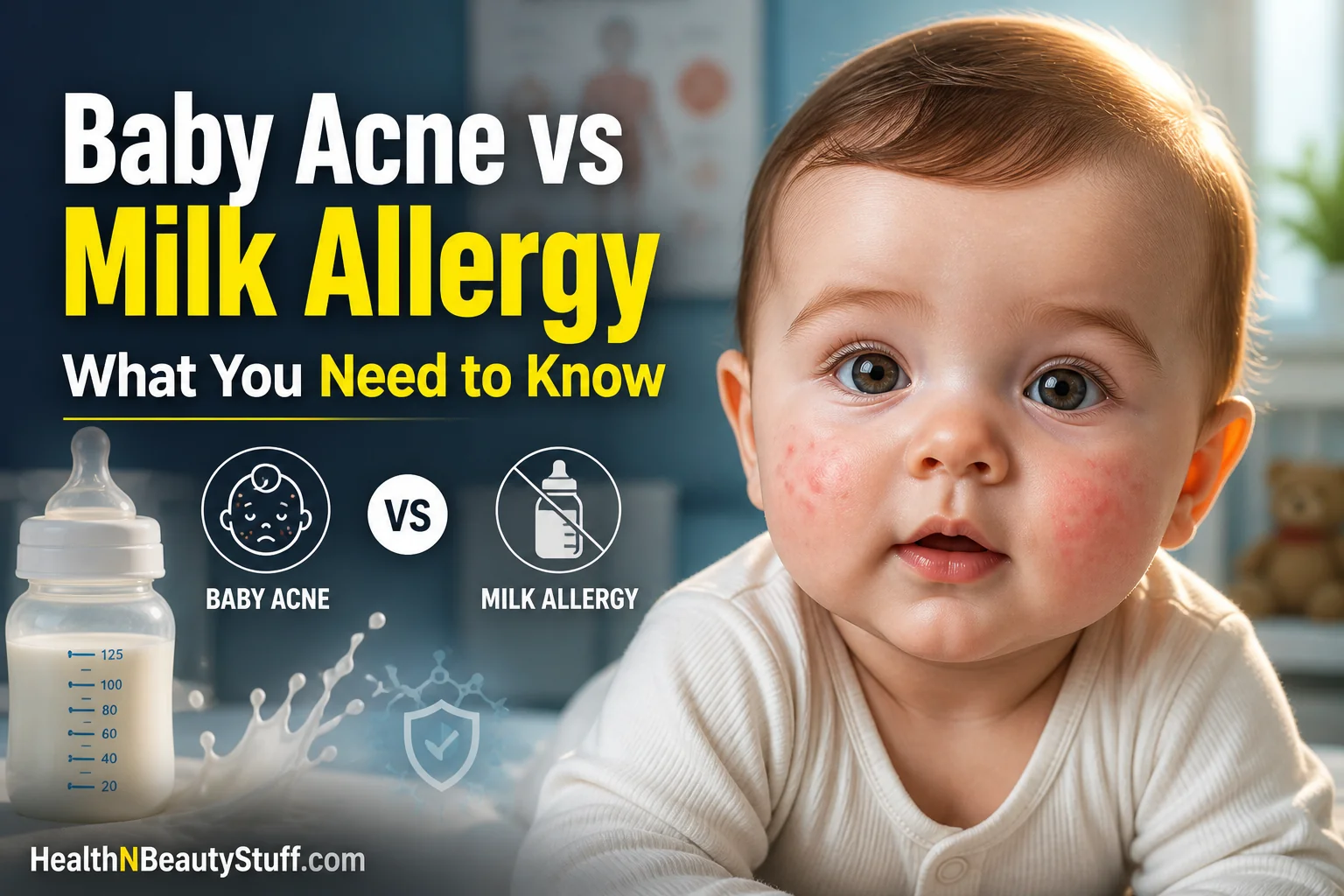
Baby Acne vs Milk Allergy: How to Tell Them Apart
You’re settling in for the 3 a.m. feed when you see it: red bumps across your baby’s cheek. Your mind races. Is it harmless baby acne, or is something in the milk causing an allergy?
Baby acne is a common, harmless rash with tiny red or white facial bumps, often starting at 2 to 4 weeks old. A milk allergy rash is more likely to be red and itchy, with digestive or breathing symptoms.
That question matters, especially when you are tired and worried. This guide offers a simple triage system, not a diagnosis. It can help you decide whether to watch the rash or call your pediatrician.
Quick Verdict: Usually, facial bumps in a comfortable newborn are baby acne. Tiny whiteheads on the cheeks often clear without treatment. An itchy rash with reflux, unusual poop, poor growth, or breathing changes may suggest cow’s milk protein allergy. Call 911 for trouble breathing, facial swelling, repeated vomiting, or sudden limpness.
Baby acne vs milk allergy at a glance
Whole-body symptoms provide the strongest clue. The rash matters, but feeding, poop, growth, and breathing matter more.
| Feature | Baby acne | Milk allergy rash (CMPA) |
|---|---|---|
| Typical age | Usually begins at 2 to 4 weeks | Can begin during the first months after milk exposure |
| Appearance | Tiny whiteheads, red bumps, or small pustules | Raised hives, rough eczema patches, or red plaques |
| Location | Mostly cheeks, forehead, and chin | Face, torso, arms, legs, or skin creases |
| Itch | Usually not itchy | Often itchy or uncomfortable |
| Other symptoms | Baby otherwise feeds and acts normally | May include vomiting, reflux, stool changes, poor growth, coughing, or wheezing |
| Response to skincare | Fades with gentle care and time | Does not resolve through skincare alone |
| Next step | Watch and use gentle skincare | Contact a pediatrician for assessment |
CMPA means cow’s milk protein allergy. It is an immune reaction to milk proteins. It is not the same as lactose intolerance, which involves trouble digesting milk sugar.
Timeline: Before 6 weeks, baby acne is the default
Baby acne appears early, while milk allergy can appear at different times. Classic newborn acne often develops between 2 and 4 weeks after birth.
The bumps may become more noticeable when your baby cries or gets warm. They often fade within several weeks, though some cases last a few months.
If a new rash starts after 6 weeks, consider other causes too. Infant acne, eczema, heat rash, and contact irritation can all affect the face.
Milk allergy reactions may be immediate or delayed. Some symptoms appear soon after feeding. Others build over hours or days. Timing alone cannot confirm CMPA.
Look: Tiny whiteheads say acne; red itchy patches suggest allergy
Whiteheads favor baby acne, while hives or eczema suggest another cause. Baby acne looks much like a small teenage breakout.
- Tiny white or red bumps
- Small pustules with pale centers
- Mild redness around the bumps
- Skin that is not usually dry or weeping
A cow’s milk protein allergy rash may look different. Hives are raised, itchy welts that may move, fade, and reappear. Eczema tends to form dry, rough, red patches.
Do not squeeze the bumps. Avoid adult acne creams, oils, and harsh scrubs. Wash the face once daily with warm water and mild baby soap.
Location: Face is common for both, but watch where it spreads
Baby acne stays mostly on the face. The cheeks are the classic spot, followed by the forehead and chin.
A milk allergy rash can also start on the cheeks. This is why location is only a weak clue. Look at what happens next.
Allergy-related hives or eczema may involve the:
- Chest and back
- Arms and legs
- Elbow or knee creases
- Neck and other skin folds
A rash spreading beyond the face deserves attention, especially when it is itchy or paired with feeding and digestive problems.
Itchiness and behavior: Does your baby act like it bothers them?
Baby acne rarely bothers a baby, but an allergic rash often does. A baby with acne usually feeds, sleeps, and settles as usual.
An itchy baby may rub their face against your chest or sheet. You might notice scratching, restless sleep, or crying during feeds.
Fussiness alone does not prove an allergy. Babies cry for many reasons. Still, persistent discomfort plus rash and digestive symptoms is more meaningful than any one sign.
Whole-body signs: The biggest tie-breaker
Poop, feeding, growth, and breathing outweigh the rash’s location. Classic baby acne does not cause symptoms elsewhere in the body.
A baby with simple acne should keep feeding and gaining weight. Their stool and breathing should remain normal for them.
Possible milk allergy baby symptoms include:
- Repeated vomiting or troublesome reflux
- Diarrhea or ongoing constipation
- Mucus or visible blood in the stool
- Poor feeding or slow weight gain
- Coughing, wheezing, or noisy breathing
- Hives, swelling, or widespread eczema
Blood in the stool or poor weight gain needs medical review. Once these signs appear, this is no longer just a skincare question.
If you’re breastfeeding: What a dairy elimination trial actually looks like
You usually do not need to stop breastfeeding. If CMPA is suspected, a pediatrician may suggest removing cow’s milk protein from your diet for 2 to 4 weeks.
This is not your fault. Eating dairy did not cause your baby to develop an allergy. You also did not miss an obvious warning sign.
A doctor-guided elimination may involve avoiding:
- Milk, cheese, yogurt, cream, and butter
- Whey, casein, and other milk proteins
- Packaged foods containing milk ingredients
Lactose-free food may still contain milk protein. That means lactose-free cow’s milk is not suitable for a milk protein elimination.
Symptoms may improve over days, but some need several weeks. A pediatrician may later recommend supervised reintroduction to check whether milk caused the symptoms.
Do not begin a strict diet alone. A pediatrician or dietitian can help protect your intake of calcium, vitamin D, protein, and calories.
If you formula-feed: When to ask about hypoallergenic formula
Ask about extensively hydrolyzed formula when CMPA is suspected. Do not grab the first can labeled “gentle” or “sensitive.”
Those standard formulas may contain intact cow’s milk protein. They are not designed to treat a confirmed milk protein allergy.
With an extensively hydrolyzed formula, milk proteins are broken into much smaller pieces. An amino acid formula contains proteins in their simplest form and may be used for severe symptoms or when hydrolyzed formula fails.
What about soy? Some babies with CMPA also react to soy protein. Soy formula may be unsuitable for certain young infants.
Change formula with pediatrician guidance. A doctor can choose the right type and decide how long to assess the response.
When baby acne and CMPA coexist
A baby can have both baby acne and a milk allergy. The conditions are not mutually exclusive.
Maybe the whiteheads appeared at 3 weeks. Then reflux worsened, feeding became difficult, or blood appeared in the diaper. The original bumps could still be acne, while the newer symptoms point elsewhere.
Use this order when clues conflict:
- First, check breathing, feeding, poop, and growth.
- Next, assess whether the rash is itchy, dry, or hive-like.
- Then discuss a supervised elimination trial with your doctor.
Do not force every symptom into one diagnosis. The full pattern matters more than a single cheek photo.
Choose neither: Eczema, heat rash, milia, and seborrheic dermatitis
Not every newborn bump is acne or milk allergy. Several common skin conditions can look similar at first glance.
Milia
Milia are tiny white pinpoint bumps, often seen on the nose, cheeks, or chin. They are harmless and usually need no treatment.
Eczema
Eczema causes dry, red, itchy patches. Food allergy can trigger or worsen eczema in some babies, but eczema alone does not prove CMPA.
A pediatrician can recommend moisturizers and other treatment if the skin is cracked, weeping, or affecting sleep.
Heat rash
Heat rash forms small red bumps after sweating or overheating. It often appears around the neck, armpits, diaper area, or other covered folds.
Seborrheic dermatitis
Greasy yellow scales suggest seborrheic dermatitis, often called cradle cap. It may affect the scalp, eyebrows, ears, and sides of the nose.
Contact irritation
A rash may follow a new lotion, wipe, soap, or laundry product. Check whether the redness matches areas touched by that product.
Wait-and-see vs act now: Pros and cons
Watching is reasonable for facial bumps in a comfortable, healthy baby. Acting now makes more sense when the rash is itchy or whole-body signs are present.
Wait and watch
- Benefit: Avoids unnecessary diet and formula changes.
- Benefit: Gives harmless baby acne time to clear naturally.
- Risk: Allergy symptoms may continue if important clues are missed.
Take a clear photo and note when the rash appeared. Use gentle skincare for 1 to 2 weeks. Track feeding, vomiting, stool changes, and comfort.
Pediatrician-led elimination trial
- Benefit: Creates a planned way to test the milk allergy theory.
- Benefit: Provides support for nutrition and formula selection.
- Challenge: Improvement can take 2 to 4 weeks.
- Challenge: A dairy-free diet can be hard to follow correctly.
An elimination trial is not a casual home test. Diagnosis often requires improvement during elimination and return of symptoms after a medically guided reintroduction.
When to call a pediatrician or get emergency help
Call a doctor for a rash with digestive or growth concerns. Call 911 for breathing trouble, major swelling, or signs of a severe allergic reaction.
Contact your pediatrician if:
- The rash spreads, oozes, bleeds, or looks infected
- Facial bumps persist or first appear after 6 weeks
- Your baby has blood or ongoing mucus in the stool
- Vomiting or reflux interferes with feeding
- Your baby feeds poorly or gains weight slowly
- The skin is very itchy or disrupts sleep
Call 911 or seek emergency help for:
- Trouble breathing, wheezing, or gasping
- Swelling of the lips, tongue, face, or throat
- Repeated vomiting with other allergy signs
- Sudden paleness, weakness, or limpness
Trust your instincts. If your baby looks seriously unwell, do not wait for the rash to become clearer.
The bottom line
Start with baby acne when the baby has facial whiteheads and feels well. It is harmless, temporary, and usually clears without medical treatment.
Think beyond acne when the rash is itchy, widespread, or joined by reflux, unusual stools, poor feeding, slow growth, or breathing changes.
Do not remove dairy or switch formula on your own. A pediatrician can assess the full pattern and guide a safe trial when needed.