New articles every week — Expert-backed health & beauty tips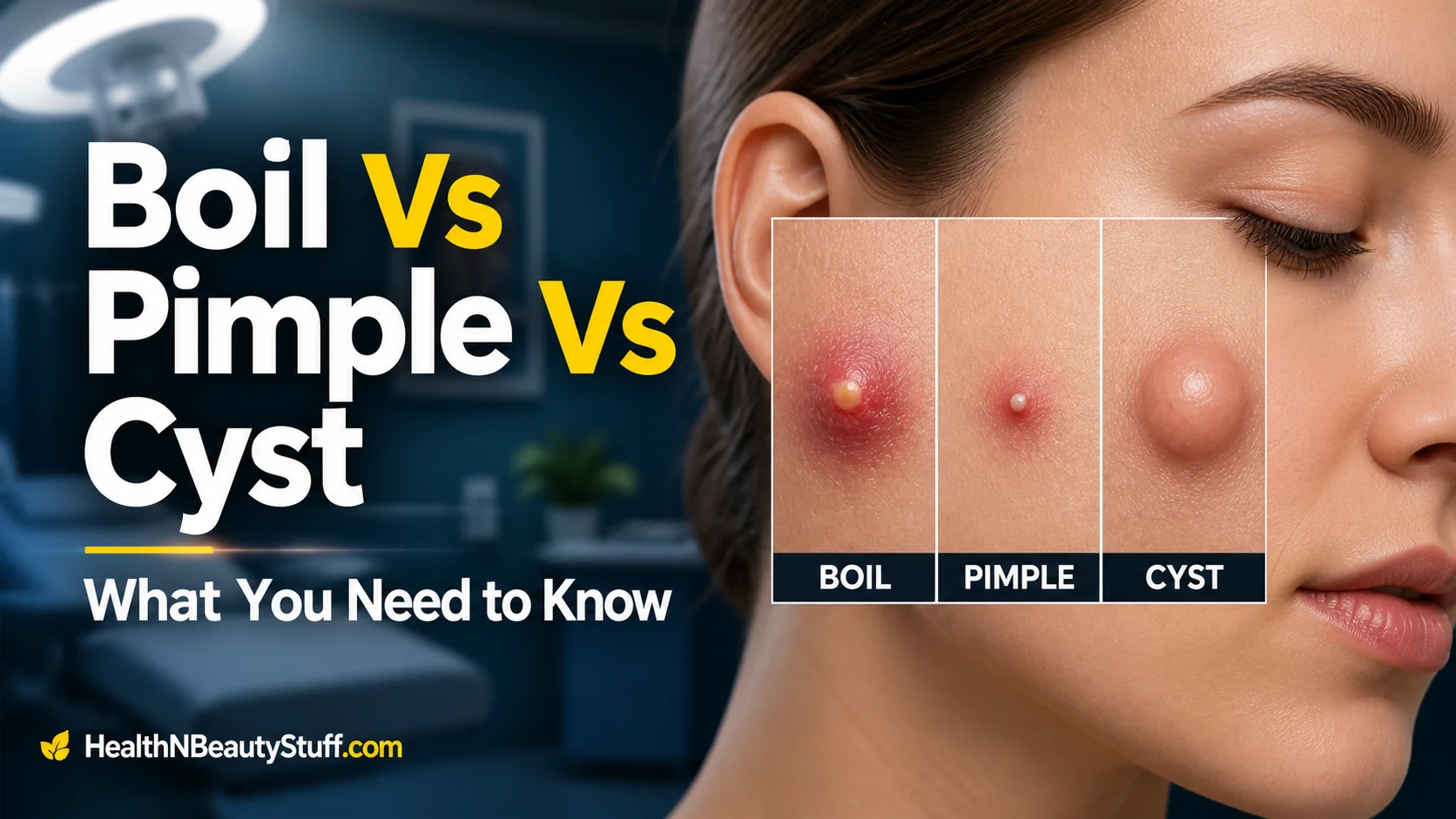
You rub the back of your neck and feel a tender lump. It was not there yesterday. Now it hurts when your collar touches it.
Your first thought may be, “Is this a pimple, a boil, or a cyst?” That question matters. The answer helps you decide whether to monitor it, use a warm compress, or call a doctor.
This can feel scary, especially when the bump is painful or growing. Most skin bumps are manageable. The key is watching pain, warmth, growth speed, and the number of bumps.
Quick Verdict: A red, hot, painful bump that grows fast is likely a boil. A firm, painless, slow-growing lump is more likely a cyst. A small surface bump near blackheads or whiteheads is probably a pimple. Do not squeeze any of them.
Boil vs pimple vs cyst at a glance
Pain, growth speed, and lesion pattern offer the strongest clues. No single sign gives a certain diagnosis, but this table can guide your next step.
| Trait | Boil | Pimple | Cyst |
|---|---|---|---|
| Root cause | Bacterial infection around a hair follicle | Pore blocked by oil and dead skin | Closed sac containing keratin, fluid, or other material |
| Feel | Warm, swollen, firm, and tender | Small surface bump or deeper tender knot | Smooth, rubbery, and sometimes movable |
| Pain | Often painful or throbbing | Mildly sore, though deep acne may hurt | Usually painless unless inflamed or infected |
| Growth | May enlarge and fill with pus over several days | May form a visible head as inflammation develops | Often grows slowly and may remain stable |
| Common locations | Neck, thighs, buttocks, groin, and armpits | Face, chest, shoulders, and back | Face, scalp, neck, back, and groin |
| Pattern | Often one bump, though several can connect | Often appears with other acne spots | Usually one distinct lump |
| Should you pop it? | No, squeezing may spread infection | No, squeezing raises inflammation and scar risk | No, squeezing leaves the cyst wall behind |
| Typical care | Warm compresses or medical drainage | Acne treatment and gentle skin care | Monitoring or complete removal by a clinician |
What Is a Boil? A Painful Infected Hair Follicle
A boil is a pus-filled infection that starts around a hair follicle. The medical name is a furuncle. Most develop after bacteria, often Staphylococcus aureus, enter irritated or damaged skin.
A boil may begin as a small red spot. It then becomes firmer, warmer, and more painful. A white or yellow center may appear as pus gathers.
- Red or darkened swollen skin
- Warmth when you touch the area
- Increasing tenderness or throbbing
- Fast growth over several days
- A soft center or visible pus-filled head
- Drainage followed by some pain relief
Several connected boils form a carbuncle. This deeper infection may cause more swelling, drainage, fever, or fatigue.
Boils are not proof of poor hygiene. Friction, sweat, shaving, skin damage, and close contact can all create an opening for bacteria.
What Is a Pimple? A Clogged Pore, Not an Infection Sac
A pimple is an inflamed pore blocked by oil and dead skin. It is part of acne, not a walled-off cyst or infected hair follicle.
Acne often produces several types of bumps in one area:
- Whiteheads: closed, flesh-colored or white bumps
- Blackheads: open clogged pores with darkened material
- Papules: small red or skin-colored inflamed bumps
- Pustules: pimples with a visible pus-filled tip
- Deep acne nodules: firm, painful bumps below the surface
A “blind pimple” is a deep acne lesion without a visible head. It can feel like a sore knot. This makes the boil vs pimple question harder.
Look at the skin around it. Nearby blackheads, whiteheads, or older acne marks favor acne. Strong warmth, rapid swelling, and worsening throbbing favor an infection.
What Is a Cyst? A Slow-Growing Sac Under the Skin
A cyst is a closed pocket beneath the skin. It may contain keratin, fluid, or other material. Most common skin cysts are epidermoid cysts and are noncancerous.
A typical cyst feels smooth or rubbery. You may be able to move it slightly beneath intact skin. Some have a tiny dark opening on the surface.
The term “sebaceous cyst” is often used loosely. Many so-called sebaceous cysts are actually epidermoid cysts, which contain keratin rather than oil from a sebaceous gland.
A painless cyst may need no treatment. However, a lump that is hard, fixed, changing, or unlike a typical cyst should be examined. Not every lump fits neatly into the cyst vs boil comparison.
Does It Hurt and Is It Hot? Pain Points to a Boil, Not a Cyst
Boils usually hurt and feel warm, while uncomplicated cysts usually do not. Pain is one of the best clues when you are checking an unfamiliar bump.
| Feature | Boil | Pimple | Cyst |
|---|---|---|---|
| Pain quality | Deep, throbbing, or steadily worsening | Sore with pressure or touch | Little or no pain |
| Warmth | Often warmer than nearby skin | Mild warmth may occur with inflammation | Same temperature as nearby skin |
| Tenderness | Often strong, even with light contact | Usually focused around the pimple | Usually absent |
| Skin appearance | Red or darkened, tense, and swollen | Small inflamed pore or acne nodule | Intact skin over a rounded lump |
There is one important catch. An infected or ruptured cyst can become hot, red, and painful. At that point, it may look almost identical to a boil or abscess.
How Fast Is It Growing? Fast Growth Means Boil, Stable Size Means Cyst
Rapid change suggests active inflammation or infection. A boil may go from a tender spot to a swollen, pus-filled bump within several days.
A cyst usually changes more slowly. You might notice the same pea-sized lump for months. It may only demand attention after clothing rubs it or the cyst becomes inflamed.
Pimples fall between these patterns. A small pimple may appear quickly, but it often comes with other acne signs. Fast growth plus heat and strong pain deserves closer attention.
Take a photo in steady lighting if you plan to monitor the bump. Do not press it repeatedly. Compare its size, redness, and pain rather than testing it every hour.
Is It One Bump or Several? Pimples Cluster; Cysts and Boils Tend to Appear Alone
Several mixed bumps in an acne-prone area usually point to acne. You may see one sore pimple beside whiteheads, blackheads, and fading spots.
A boil or cyst is more often a single, distinct lump. Multiple boils can occur, though. Connected boils may form a carbuncle and need medical care.
What if painful “boils” keep returning in the armpits, groin, under the breasts, or around the buttocks? Recurring deep lumps may signal hidradenitis suppurativa, also called HS.
HS is a long-term inflammatory condition. It is not caused by poor hygiene. Early dermatology care may help control flares and limit tunnels or scars.
Can a Pimple Turn Into a Boil? Can a Cyst Become Infected?
A pimple does not literally turn into a boil, but inflamed skin can become infected. A deep acne lesion may also resemble a boil from the start.
The process can look like this:
- A pore becomes blocked.
- Inflammation creates a tender acne bump.
- Skin damage or squeezing introduces more bacteria.
- Swelling and pus increase, creating an abscess-like lesion.
A cyst can follow another path. Its wall may rupture below the skin, releasing irritating material. Redness and pain can then develop, even without a bacterial infection.
If bacteria enter, the cyst may form a painful abscess. Treatment may first focus on the infection. The remaining cyst wall may require later removal after inflammation settles.
Can You Pop It? Why the Answer Is No for All Three
Do not pop, puncture, or squeeze a boil, pimple, or cyst. It may feel like the fastest solution, but pressure can make the problem deeper.
- Boil: squeezing may push bacteria into nearby tissue and spread infection.
- Pimple: picking increases swelling, dark marks, and scar risk.
- Cyst: pressure may rupture it internally, while the cyst wall remains.
Never cut a bump with a needle or blade at home. Medical drainage uses clean equipment, pain control, and wound care.
If a boil opens by itself, do not force out the contents. Let it drain onto clean gauze. Wash your hands, clean the surrounding skin gently, and apply a fresh bandage.
At-Home Care: Warm Compress, Hands Off, and When to Stop
Gentle care and careful monitoring are enough for many small, uncomplicated bumps. The right approach depends on what the bump is doing.
For a possible boil
- Apply a warm compress for 10 to 15 minutes.
- Repeat three or four times each day.
- Use clean cloths and wash your hands afterward.
- Cover drainage with clean, dry gauze.
- Do not share towels, razors, or washcloths.
For a pimple
Use gentle acne care rather than pressure. Over-the-counter benzoyl peroxide or salicylic acid may help common acne when used as directed.
Avoid stacking several harsh products. Burning and peeling will not make a deep bump disappear faster.
For a cyst
Leave a painless, unchanged cyst alone unless it bothers you. A warm compress may soothe an inflamed cyst, but it cannot remove the cyst wall.
| Option | Benefits | Limits |
|---|---|---|
| Home care | Private, low cost, and suitable for a small stable bump | Cannot drain a deep abscess or remove a cyst wall |
| Medical care | Provides diagnosis, sterile drainage, testing, and prescription treatment | Requires an appointment and may involve procedure fees |
Stop home care if pain, swelling, heat, or redness is increasing. Worsening symptoms mean the plan needs to change.
When to See a Dermatologist vs Urgent Care vs ER
Get medical help when the bump is severe, spreading, recurring, or uncertain. Your symptoms and health history decide where to go.
Book a dermatologist
- A cyst keeps refilling or catches on clothing.
- Deep acne is causing pain or scars.
- Boil-like lumps keep returning.
- You may have hidradenitis suppurativa.
- A lump is hard, fixed, growing, or difficult to identify.
Choose primary or urgent care
- The boil is very painful or continues to enlarge.
- It has not improved after several days of warm compresses.
- It is on the face or near the spine.
- You may need drainage or antibiotics.
Seek urgent emergency evaluation
- Fever, chills, or feeling seriously unwell
- Red streaks moving away from the bump
- Rapidly spreading redness or swelling
- Severe pain that seems greater than the skin changes
- Facial swelling near the eye, nose, or mouth
- Confusion, weakness, faintness, or trouble breathing
Seek care earlier if you have diabetes, poor circulation, or a weakened immune system. Parents should also call sooner for a young child with a painful or worsening bump.
Treatment and Cost: What a Doctor Might Actually Do
Treatment may involve drainage, acne medicine, cyst removal, or simple monitoring. The clinician first checks the bump’s location, depth, redness, and drainage.
For a boil or abscess, a clinician may perform incision and drainage:
- Numb the area with a local anesthetic.
- Make a small opening.
- Allow pus to drain.
- Place packing when medically appropriate.
- Explain cleaning, bandaging, and follow-up.
Not every boil needs antibiotics. The decision depends on spreading infection, fever, health risks, location, and other clinical findings. A sample may be tested when resistant bacteria are a concern.
A quiet cyst may need no procedure. If it is painful, infected, growing, or bothersome, a dermatologist may recommend complete excision. Removal of the cyst wall helps prevent refilling.
Deep acne may be treated with prescription creams, oral medicine, or an injection into a severe lesion. Treatment should address the wider acne pattern, not just one bump.
Costs vary by clinic, insurance, location, tests, and procedure type. Ask for a written estimate before nonurgent treatment. Confirm whether pathology testing, wound supplies, and follow-up visits are separate charges.
“It Depends”: HS, Diabetes, MRSA, and Recurrent Boils
If boils keep returning, do not assume it is bad luck. Repeated infections or boil-like lumps deserve a closer look.
- Armpit or groin recurrences: Ask about hidradenitis suppurativa.
- Diabetes: Infection may worsen faster or heal more slowly.
- Weak immune system: Seek medical advice at an earlier stage.
- Possible MRSA: A clinician may collect drainage for testing.
- Pregnancy: Check before using acne medicines or antibiotics.
- Young child: Contact a clinician for a painful, hot, or growing bump.
MRSA cannot be confirmed by appearance alone. It is a type of staph bacteria resistant to certain antibiotics. Testing guides treatment when it is suspected.
Repeated squeezing can also blur the picture. It adds swelling and skin damage, making acne, cysts, and boils harder to tell apart.
What Is My Bump Most Likely to Be?
A hot, painful, fast-growing bump is most consistent with a boil. A slow, rubbery, painless lump fits a cyst. Several smaller bumps with clogged pores favor acne.
- Likely boil: red, hot, tender, enlarging, and possibly pus-filled
- Likely cyst: smooth, slow-growing, firm or rubbery, and usually painless
- Likely pimple: surface-level or deep acne bump near other clogged pores
An infected cyst can look exactly like a boil. A blind pimple may also feel deep and sore. When the signs overlap, do not squeeze the bump to “test” it.
Monitor a calm bump, use gentle care for a small boil or pimple, and seek help for red flags. If the lump is hard, fixed, steadily growing, or unfamiliar, let a clinician examine it.