New articles every week — Expert-backed health & beauty tips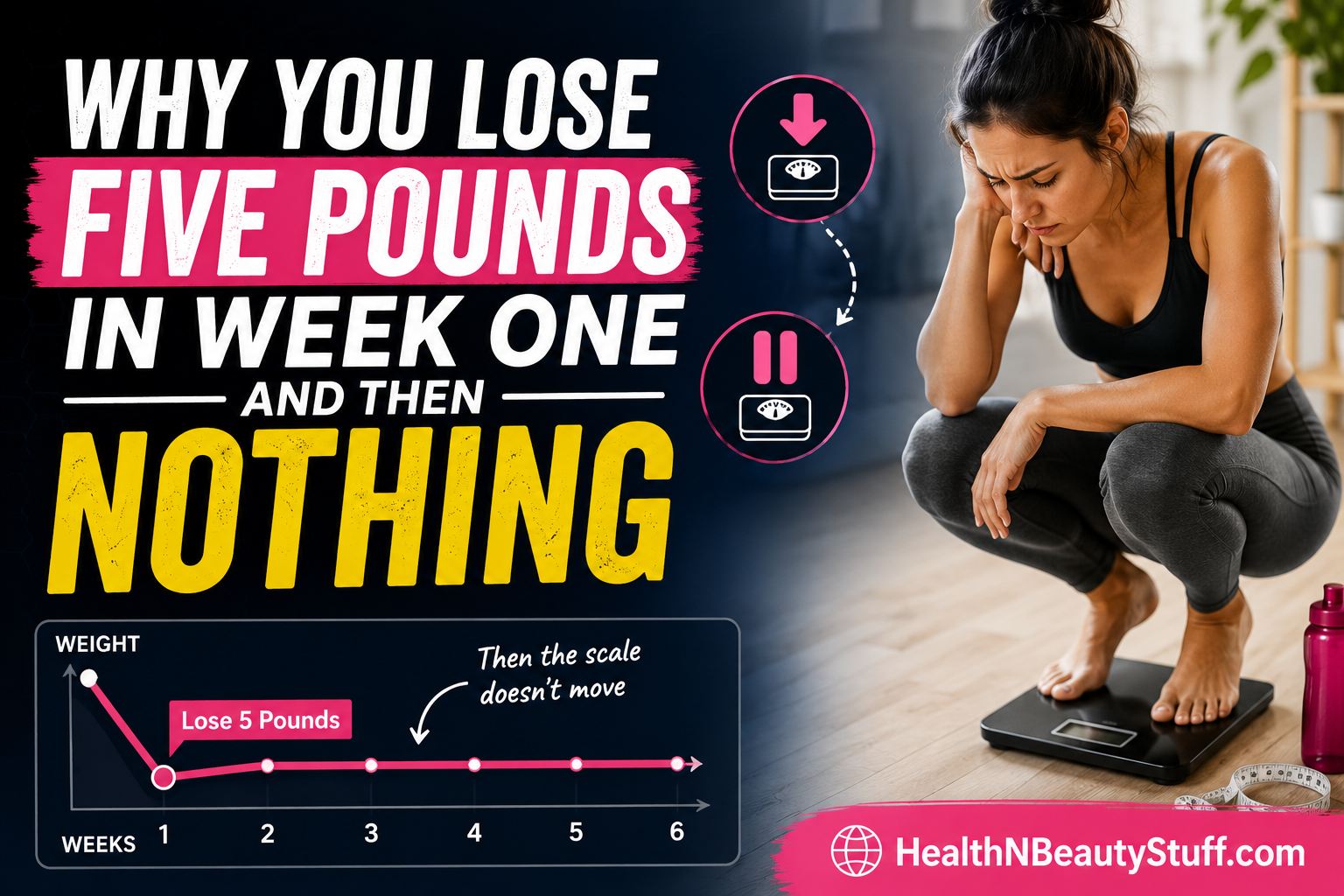
Almost everyone who starts a diet has the same two weeks. The first one is thrilling. The scale drops three, four, sometimes six pounds, and the whole thing feels easy. Then week two arrives, the number stops moving, and it feels like the diet broke.
Nothing broke. What happened is that week one was never measuring what you thought it was measuring.
Week one is mostly water
Your body stores carbohydrate as glycogen, in your muscles and liver, and glycogen is stored wet. Each gram of it holds roughly three grams of water alongside it. A typical adult carries somewhere in the region of 400 to 600 grams of glycogen when fully stocked.
Cut your calories, and particularly cut your carbohydrates, and you burn through that glycogen in the first few days. The water it was holding leaves with it. That is several pounds on the scale before you have lost any meaningful amount of fat at all.
The same thing happens in reverse the moment you eat a normal amount of carbohydrate again, which is why a single large meal can appear to undo a week of effort overnight. It has not. You have refilled a tank, not regained fat.
The arithmetic that proves it
A pound of body fat stores roughly 3,500 calories. That number is an approximation rather than a law, but it is close enough to reason with.
Run the maths on what that means for a week. A 250 calorie daily deficit is 1,750 a week, or about half a pound of fat. A 500 calorie daily deficit is 3,500 a week, or about a pound. A 1,000 calorie daily deficit is 7,000 a week, or about two pounds.
To have genuinely lost five pounds of fat in seven days, you would need a deficit of 2,500 calories every single day. For most people that is more than they eat. It is not possible, so the five pounds was not fat.
This is also why the second week feels like failure when it is often the opposite. The water is gone, so from here the scale can only move at the speed fat actually leaves, which is slow and unglamorous and completely normal.
Where liquid diets fit
Very low calorie and liquid approaches produce the most dramatic version of this pattern, because they cut carbohydrate hardest and fastest. The glycogen empties almost immediately, the water goes with it, and the first few days look spectacular.
That early number is what makes these diets feel like they are working better than anything else. It is also why people are so disappointed by week three, when the rate of loss settles down to what any other deficit of the same size would have produced anyway.
It is worth knowing this before you start, rather than concluding halfway through that your metabolism is broken.
What to measure instead
Weigh yourself daily, then ignore every individual reading and compare weekly averages against each other. Daily weight swings by two or three pounds on water, sodium, and what is still in your digestive system. A weekly average smooths all of that out and shows you the actual trend.
Give it three weeks before drawing any conclusion. One week tells you nothing. Two weeks tells you very little. Three weeks of averages tells you whether your deficit is real.
Track something other than weight as well. Waist measurement, how your clothes fit, photographs in the same light every fortnight, and what you can lift. These often move when the scale is being stubborn, and they are frequently the better signal.
Getting the deficit right
The size of the deficit matters more than the style of the diet, and bigger is not automatically better.
Around 250 to 300 calories a day suits people with less than fifteen pounds to lose, or anyone training seriously who cannot afford to feel flat. It is slow, and small tracking errors can wipe it out entirely.
Around 500 calories a day is the standard recommendation for most people, and it earns that reputation. It produces visible progress within a few weeks and stays tolerable long enough to actually finish.
Deficits of 750 to 1,000 calories a day make sense when there is a lot of weight to lose, but they are harder to sustain, hungrier, and come with a greater risk of losing muscle alongside fat. Protein intake and resistance training matter considerably more at that end.
If you want the full breakdown of how big your calorie deficit should be, including how to estimate what you burn in the first place, it is worth working out your own number rather than borrowing someone else’s.
The deficit you can hold for twelve weeks will always beat the one that collapses in three.