New articles every week — Expert-backed health & beauty tips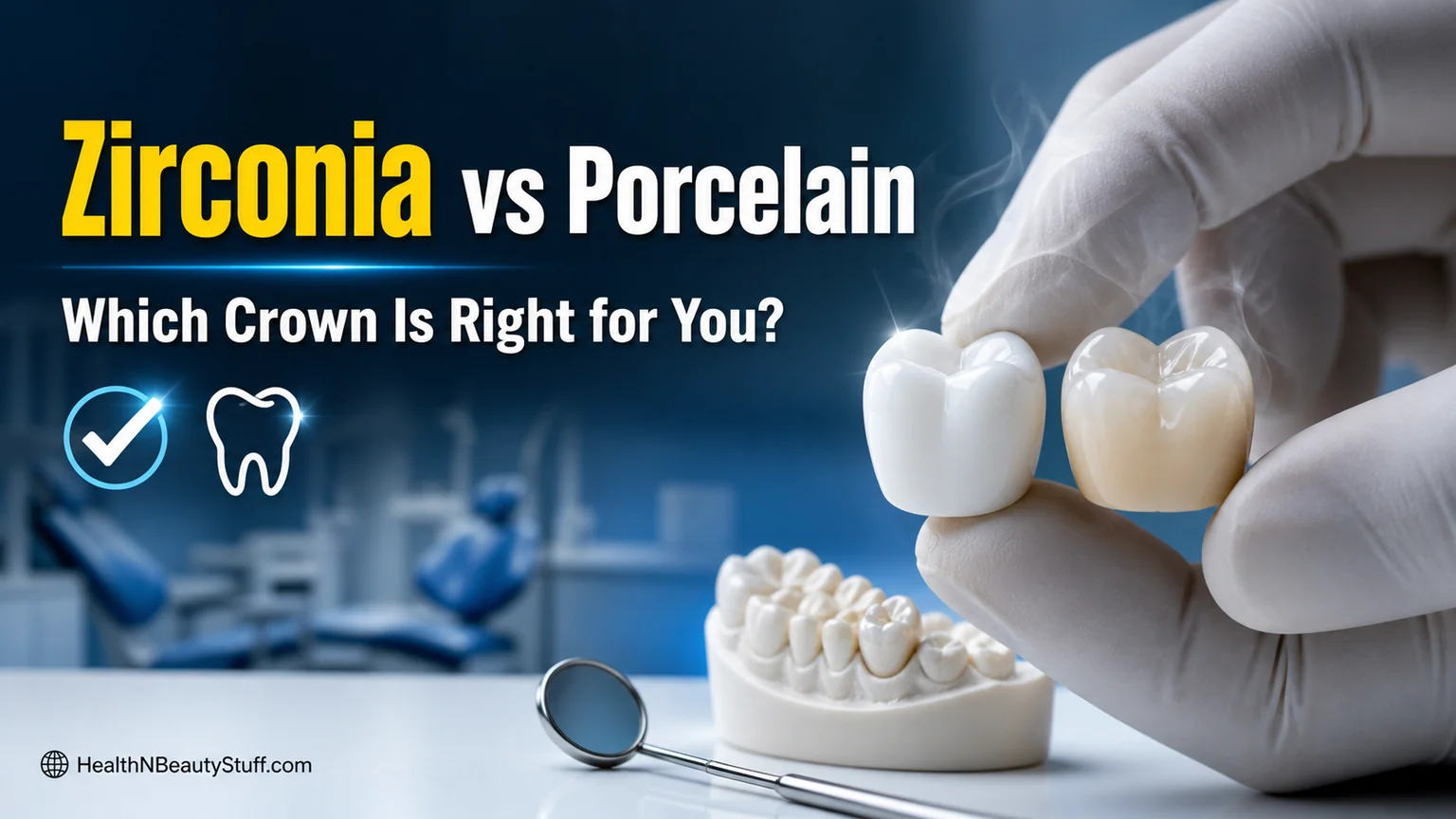
Your dentist leans back, clicks through some X-rays, and says, "Okay, you need a crown. Do you want zirconia or porcelain?" You stare at the ceiling. You were not expecting a pop quiz. You just wanted to fix your tooth.
That moment of blankness is normal. Most people have never had to think about crown materials before. But the choice actually matters, and it is not as complicated as it sounds once someone explains it plainly.
Here is what you need to know before you answer.
Quick Verdict: It's a Draw
Zirconia wins on strength. It handles heavy bite forces, resists cracking, and lasts longer on average. It is the go-to for back molars.
Porcelain wins on beauty. It transmits light the way real teeth do. For front teeth that show when you smile, porcelain looks more natural.
The right choice depends on where the tooth is, how hard you bite, and your budget. Neither material is universally better. Your dentist knows your mouth. Use this article to have a smarter conversation with them.
Zirconia Crown vs Porcelain: At a Glance
| Feature | Zirconia | All-Ceramic Porcelain |
|---|---|---|
| Strength | Excellent (highest of any crown) | Good (can chip under heavy force) |
| Natural Look | Good to very good (layered) | Excellent (best light transmission) |
| Typical Lifespan | 15-20 years (monolithic) | 10-15 years |
| Cost (per tooth) | $1,300-$2,500 | $1,200-$2,000 |
| Best For | Molars, grinders, heavy biters | Front teeth, high-smile-line cases |
What Is a Zirconia Crown vs a Porcelain Crown?
Think of it as two different recipes for making a fake tooth cap, both ceramic but engineered very differently.
Zirconia is short for zirconium dioxide, a ceramic that happens to be incredibly tough. Dentists mill it from a solid block using a CAD/CAM machine. It is metal-free, white, and does not corrode. Monolithic zirconia is one solid piece. Layered zirconia has a zirconia core with hand-crafted porcelain baked on top for a more natural look.
All-ceramic porcelain (including e.max, which is lithium disilicate glass-ceramic) is also metal-free. It is less dense than zirconia, which means light passes through it the same way it does through a real tooth. That is why it looks so lifelike. The trade-off is that it is more brittle under extreme force.
There is also a third option worth knowing: porcelain-fused-to-metal (PFM). It has a metal inner shell coated with porcelain. Strong and affordable, but that metal core can show as a grey line at the gumline over time, especially if your gums recede.
Strength and Durability: Why Molars Favor Zirconia
Your back teeth take a beating. Every time you chew, your molars generate forces your front teeth will never see. That is why material strength is not just a marketing stat for back-tooth crowns. It directly affects how long your crown lasts.
Zirconia is the strongest crown material available. Monolithic zirconia resists cracking even under heavy, repeated bite forces. It does not chip the way porcelain can. For that reason, most dentists default to zirconia for second molars and premolars.
Typical lifespan numbers, from Willow Family Dentistry's 2026 clinical data:
- Monolithic zirconia: 15-20 years
- Layered zirconia: 12-18 years
- All-ceramic porcelain / e.max: 10-15 years
One thing to know: zirconia is so hard it can wear down the opposing tooth if the bite is not adjusted properly. A skilled dentist will polish the crown and check your bite before you leave. If you grind your teeth, a night guard becomes important. More on that below.
Appearance: Why Front Teeth Favor Porcelain
You smile and the first four to six teeth on the top row are front and center. Every person you talk to can see them. For those teeth, looks matter as much as strength.
Here is the problem with standard zirconia: it is opaque. It looks white, but it does not have the translucency of a real tooth. In bright light, it can look slightly flat or artificial next to your natural teeth. Layered zirconia is better, but the porcelain overlay that gives it beauty is also its weakest point.
All-ceramic porcelain, especially e.max, transmits light the way real enamel does. It has depth. It blends. In the hands of a good dental lab, it is nearly impossible to distinguish from the surrounding teeth.
If your smile line is high (meaning your gums show when you smile) or you have a gap tooth being crowned in a visible spot, porcelain gives you the most natural result. That aesthetic advantage is the reason it remains the front-tooth standard despite being less durable than zirconia.
Cost Comparison: Zirconia vs Porcelain Crown Cost
The honest answer is that both materials land in a similar price range. The bigger cost drivers are your dentist's fee, your location, and whether you have insurance.
Here are the 2026 verified ranges per tooth (without insurance), based on Willow Family Dentistry and RealDentalCosts data:
- Monolithic zirconia: $1,300-$2,000
- Layered zirconia: $1,800-$2,500
- All-ceramic porcelain: $1,200-$2,000
- E.max (lithium disilicate): $1,500-$3,000, average around $1,600
- Porcelain-fused-to-metal (PFM): $800-$2,000, average around $1,100
Most people without insurance pay somewhere between $1,000 and $1,800 for a single crown. With a standard dental plan, your out-of-pocket cost typically drops to $500-$900 after coverage kicks in.
The takeaway: zirconia and all-ceramic porcelain cost roughly the same. If budget is tight and you need a back molar covered, PFM is the lowest-cost option that still holds up well. It just may not age as gracefully at the gumline.
What If You Grind Your Teeth, Have Sensitive Gums, or an Old Metal Crown?
These situations come up constantly, and they change the material math.
If you grind your teeth (bruxism):
- Zirconia handles grinding forces better than porcelain
- But its hardness can wear down opposing natural teeth over time
- Your dentist should polish the crown contact points carefully
- A night guard is strongly recommended regardless of material
If you have gum sensitivity or receding gums:
- Metal-free options (zirconia or all-ceramic) reduce irritation risk
- PFM crowns can expose the metal margin as gums recede, showing a grey line
- Zirconia is often the better long-term pick if gum recession is a concern
If you are replacing an old metal or PFM crown:
- Going metal-free is possible in most cases
- Your dentist will assess whether enough tooth structure remains
- Zirconia is often chosen for replacement back crowns because of its strength and metal-free status
Root Canal Plus Crown: The Workflow No One Tells You About
You got a root canal. Now your dentist says you need a crown too. It feels like the bad news keeps piling up. But there is a reason for it, and understanding the sequence helps.
A tooth that has had a root canal is structurally weaker. The pulp is gone. There is less internal support. Without a crown, the tooth is at real risk of cracking under normal chewing. A crack in a molar can reach below the gumline and the tooth may not be saveable.
The typical workflow looks like this:
- Root canal is completed (one to three visits depending on complexity)
- A temporary crown or build-up protects the tooth
- A permanent crown is placed a few weeks later after any swelling resolves
- Some offices use CEREC (same-day digital milling) and can do it faster
For molar root canal cases, zirconia is usually the first recommendation. The tooth needs protection from heavy bite forces, and zirconia delivers that better than any other material. Front teeth treated with root canals may still use porcelain if aesthetics are the priority.
It Depends: When to Choose Zirconia, Porcelain, or Neither
Here is the cheat sheet. Run through the situation that fits yours.
Choose zirconia when:
- The tooth is a back molar or premolar
- You have a heavy bite or clench/grind at night
- You have had a root canal on a back tooth
- You want durability and a longer potential lifespan
- Metal allergies or gum sensitivity are a concern
Choose all-ceramic porcelain when:
- The tooth is in the front of your mouth and visible when you smile
- Matching your natural tooth color perfectly is a top priority
- You do not have a heavy bite on that particular tooth
- Your dentist has a high-quality dental lab relationship for aesthetic work
Consider PFM when:
- Budget is the main constraint and the tooth is in a less visible position
- You need extra strength but layered zirconia is outside your budget
- Your dentist recommends it based on specific bite mechanics
Ask more questions when:
- The recommendation feels rushed or unexplained
- You are not sure whether the crown is even necessary right now
- A second opinion would give you peace of mind
Final Verdict
This is a draw between two materials that are genuinely good at different things. There is no wrong choice if you pick the right material for the right tooth.
Zirconia is the stronger, longer-lasting option. Porcelain is the more beautiful option. For most people, the answer comes down to location in the mouth. Back tooth: zirconia. Front tooth: porcelain. Mixed situation: ask your dentist which matters more for your specific case.
Before you say yes to any material, here are three questions worth asking your dentist:
- "For my specific tooth position, which material do you usually recommend and why?"
- "If I choose zirconia, will it match my surrounding teeth well enough?"
- "Do I grind my teeth in a way that changes this recommendation?"
A good dentist will welcome those questions. The answers will tell you exactly what to choose.