New articles every week — Expert-backed health & beauty tips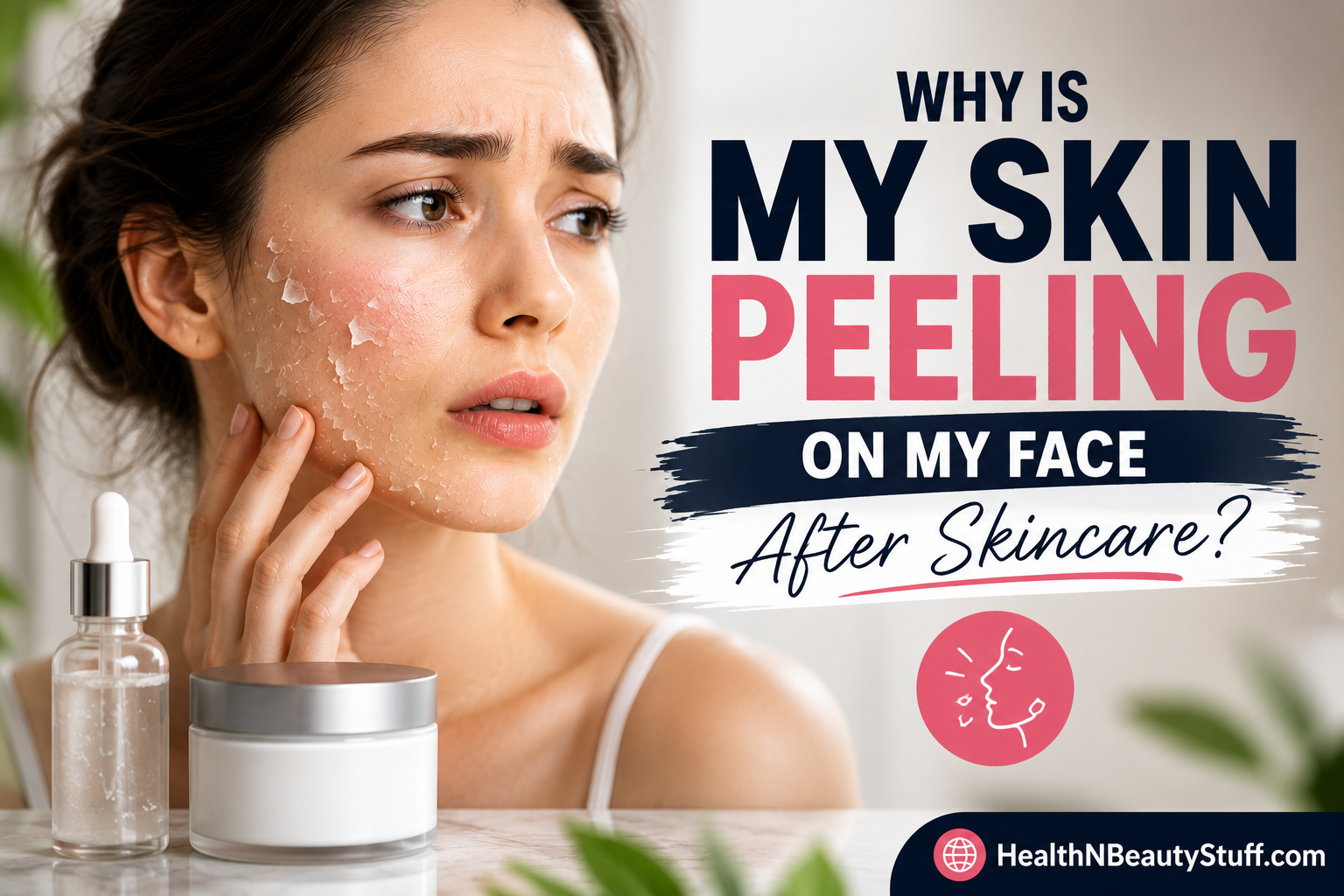
You did everything right. You washed, you serum-ed, you moisturized. And now your face feels like it’s shedding like a snake in reverse. Tight, flaky, shiny in the weirdest spots. You’re staring in the mirror thinking… did that $40 serum just ruin my face?
I get it. I’ve been there, more than once. And here’s the thing most beauty brands won’t tell you up front: some peeling is your skin adjusting. But a lot of it is a warning sign. The trick is knowing which one you’ve got.
The skincare industry loves to make this confusing. “Mild peeling is normal,” they’ll say, while selling you a 10-step routine that includes a 20% acid peel. So how do you tell if your skin is healing or breaking down?
Stick with me. By the end, you’ll know exactly why your skin is peeling on your face after skincare, whether it’s a problem, and what to do tonight.
Quick Answer — What’s Happening to Your Skin?
If your face is peeling after your skincare routine, the short version is this: your skin barrier is most likely compromised. That means the outermost layer of your skin (the stratum corneum) has lost some of its protective lipids and can’t hold moisture the way it should. So it gets dry, cracks, and starts flaking.
Three things usually cause it:
- Over-exfoliation with acids, retinol, or scrubs. The most common reason.
- Active ingredients stacking like retinol plus vitamin C plus AHA in one routine.
- An actual reaction to a fragrance, preservative, or ingredient your skin doesn’t tolerate.
Sometimes what looks like peeling is actually purging, which is different. Purging is your skin pushing out clogged stuff faster because an active increased cell turnover. It looks gnarly but it’s temporary. Damage peeling feels more like tightness, burning, and flaking in places you don’t normally break out.
Here’s the bottom line: stop all your actives right now, simplify your routine to a gentle cleanser, plain moisturizer, and sunscreen, and let your skin calm down for 7 to 14 days. Most cases resolve on their own if you don’t keep poking the bear.
Understanding Your Skin Barrier — The Science of Peeling
Your skin barrier is honestly a little miracle of biology. Picture a brick wall. The bricks are your dead skin cells (corneocytes). The mortar between them is made of lipids, mostly ceramides, cholesterol, and fatty acids. Together they form the lipid matrix.
When that mortar is intact, water stays in, irritants stay out, and your skin looks smooth. When it gets damaged, water escapes through transepidermal water loss (TEWL). That’s when you get the tight, papery feeling. And once the barrier cracks, those flakes on your chin? Those are the bricks falling out of the wall.
A healthy barrier also keeps your acid mantle at the right pH, somewhere between 4.5 and 5.5. Slightly acidic. When you wash with a harsh cleanser, that pH jumps, the mantle gets disrupted, and bad bacteria love it. So damaged skin barrier repair isn’t just about slapping on moisturizer. It’s about restoring lipids, pH, and the whole protective system.
This is why skin peeling after skincare isn’t always about a single bad product. It’s usually about the cumulative effect of routines that were too much, too fast.
7 Common Causes of Skin Peeling After Skincare
1. Over-Exfoliation — The #1 Culprit
I’ll say it louder for the people in the back. Over-exfoliation is the reason most people end up with peeling skin. We get sold the dream that “smoother, brighter skin” comes from sloughing off dead cells, and we go wild. Physical scrubs with walnut shells, daily glycolic pads, AHA toners every night, plus a retinol. By Tuesday your face is falling off.
The over exfoliation symptoms are pretty distinctive:
- Skin that looks shiny but feels tight
- Redness that doesn’t go away
- Stinging when you apply products that shouldn’t sting (like moisturizer)
- Visible peeling, especially around the nose, mouth, and chin
- Small bumps that aren’t quite pimples
If this is you, stop. Just stop. More exfoliation will not fix exfoliation damage.
2. Retinoids and Active Ingredients
Retinoids (retinol, tretinoin, adapalene) are the gold standard for anti-aging and acne. They’re also notorious for causing peeling, dryness, and what the internet lovingly calls the “retinoid uglies.” That adjustment period can last 2 to 6 weeks and it’s rough.
The same goes for high-strength vitamin C (L-ascorbic acid), benzoyl peroxide, and concentrated AHA/BHA exfoliants. They all work by speeding up cell turnover, and they all can shred your barrier if you overdo it.
Here’s a hack: the Sandwich Method. Apply your moisturizer first, then your active, then another layer of moisturizer. It dilutes the active just enough to reduce irritation while still getting results. Game changer for retinol newbies.
3. Allergic Reactions and Ingredient Sensitivities
Not all peeling is from too much exfoliation. Sometimes your skin is straight up mad at an ingredient. Common offenders include synthetic fragrances, essential oils, harsh preservatives like methylisothiazolinone, and some plant extracts.
This is where patch testing saves lives. Dab a little new product behind your ear or on your inner wrist, then wait 48 hours. If it’s red, itchy, or bumpy, don’t use it on your face.
If you know you’re sensitive, look for brands that keep formulations clean and minimal. Jurlique’s farm-grown, fragrance-conscious approach is a good example. Their Rosewater Balancing Mist is a soothing alternative to alcohol-based toners, and it skips the synthetic fragrance most mists hide behind.
4. Harsh Cleansers and pH Imbalance
Here’s a mistake I made for years: using a foaming cleanser that left my face feeling “squeaky clean.” That squeak? That’s your acid mantle being stripped. Most foaming cleansers use sulfates (SLS, SLES) and run at a pH of 8 or 9, way above your skin’s natural 4.5 to 5.5.
When your pH is off, your barrier can’t repair itself properly. So even if your serum and moisturizer are perfect, your cleanser is undoing all of it twice a day.
A gentle, pH-balanced cleanser makes a huge difference during recovery. Yay for Earth’s Sensitive Skin Face Lotion is formulated with minimal, pH-balanced ingredients, ideal for skin that’s currently freaking out. Their whole approach is small-batch and stripped down, which is exactly what compromised skin needs.
5. Environmental Factors — Weather, Sun, and Humidity
Sometimes the peeling isn’t your products at all. It’s the weather. Cold winter air pulls moisture out. Indoor heating makes it worse. Summer sun can cause sunburn peeling. And if you live somewhere dry, low humidity alone will dry your face out.
The fix: a good moisturizer with humectants (hyaluronic acid, glycerin) and occlusives (shea butter, squalane), plus SPF 30+ every day, even when it’s cloudy. The sun doesn’t take snow days.
6. Dehydration vs. Dry Skin
These two get mixed up constantly, and the fix is different for each.
Dry skin is a skin type. You lack oil. Your skin feels tight, looks flaky, and rarely gets shiny.
Dehydrated skin is a condition. You lack water. You can have oily, combination, or even acne-prone skin and still be dehydrated.
Dehydration often shows up as dullness, fine lines that seem to appear out of nowhere, and yes, peeling. Drinking more water helps, but topical hydration matters more.
If your skin is reactive and you need something gentle, Osmia Skincare’s Purely Simple Face Cream is doctor-formulated for sensitive and reactive skin types. Their whole brand is built around calming ingredients that don’t trigger reactions.
7. Underlying Skin Conditions
Sometimes peeling isn’t about your routine. It’s a condition.
Seborrheic dermatitis causes flaky patches around the nose, eyebrows, and scalp. Eczema brings red, itchy, peeling patches. Psoriasis creates thick, scaly plaques. Contact dermatitis shows up after exposure to an allergen.
If your peeling came out of nowhere, won’t go away after 2 weeks of gentle care, or comes with oozing or severe itching, see a dermatologist.
Skin Purging vs. Bad Reaction — How to Tell the Difference
This trips up almost everyone. You’re using a new retinol, your skin gets worse, and you’re wondering if it’s working or destroying your face.
Here’s the cheat sheet:
| Purging | Bad Reaction |
|---|---|
| Happens where you normally break out | Happens in places you never get pimples |
| Small whiteheads or blackheads | Rash, hives, or widespread redness |
| Resolves in 4 to 6 weeks | Gets worse with continued use |
| Skin feels slightly dry but not painful | Burning, itching, or stinging |
| Cycle follows your normal breakouts | No pattern, just chaos |
The rule: if it’s a known active (retinoid, AHA, BHA, benzoyl peroxide) and the breakout matches your normal acne pattern, give it 6 weeks. If it’s anything else, or if the symptoms are painful, stop and simplify.
How to Fix Peeling Skin — A Step-by-Step Recovery Plan
Step 1: Stop All Active Ingredients Immediately
This is the hard part. No retinol tonight. No glycolic acid. No vitamin C serum. Nothing with active ingredients. Pause everything for 7 to 14 days, depending on how damaged your barrier is. Yes, even your beloved retinol. Especially your beloved retinol.
Step 2: Simplify to the Bare Essentials
For the next two weeks, your routine is three products:
- A gentle, fragrance-free cleanser
- A plain, rich moisturizer
- A mineral sunscreen (SPF 30+)
That’s it. This is your gentle skincare routine for the recovery window. No toners, no essences, no treatments, no experimental products. Less is more. More is a nightmare.
If you need a moisturizer that hydrates without irritating, Jurlique’s Moisture Replenishing Day Cream provides rich, organic hydration without the synthetic additives that often trigger reactions. Botanicals that have been used in skincare for centuries, formulated properly.
Step 3: Rebuild the Skin Barrier
This is where you look for specific barrier-repair ingredients:
- Ceramides — replace the lipids that are missing
- Niacinamide — calms inflammation, supports barrier function
- Squalane — mimics your skin’s natural oils
- Fatty acids — reinforce the lipid matrix
- Centella asiatica (cica) — soothes and repairs
Avoid anything with fragrance, denatured alcohol, or essential oils during recovery. They’re just adding fuel to the fire.
For the best moisturizer for peeling skin, look for one that has ceramides and is free of fragrance. Osmia Skincare’s Balance Natural Facial Serum uses doctor-formulated oils to restore the lipid barrier without overwhelming reactive skin. Oils that work with your skin, not against it.
Step 4: Reintroduce Products Slowly
After 7 to 14 days, your barrier should feel better. Not perfect, but better. Now you can start adding things back. But slow. One product at a time, with 3 to 5 days between each new addition. That way if something triggers a reaction, you know exactly what caused it.
Start with the lowest concentration and shortest contact time. Retinol 0.25% twice a week, not 1% nightly. Vitamin C at 10%, not 20%. Glycolic at 5%, not 30%. You can always build up. You can never un-damage your barrier.
Step 5: Support from the Inside Out
Skincare isn’t just what you put on your face. Your skin is an organ, and it reflects what’s happening inside. So:
- Drink enough water (half your body weight in ounces is a fine starting point)
- Eat omega-3 fatty acids (salmon, walnuts, flaxseed)
- Run a humidifier at night if you live somewhere dry
- Get enough sleep (yes, your skin repairs itself while you sleep)
None of this is a magic fix, but it all adds up.
How to Prevent Peeling Skin in the Future
Once you’ve recovered, you don’t want to go back. So here’s how to keep your barrier happy long-term.
Patch test everything. Every new product, every time. Even brands you’ve used for years reformulate, and your skin can change too. Two minutes of testing saves two weeks of recovery.
Introduce actives gradually. Don’t start three new products on the same Monday. Add one. Wait. See how your skin responds. Then add the next.
Listen to your skin. If something stings, it stings. If your skin feels tight after cleansing, your cleanser is too harsh. If you’re peeling in places you normally don’t, something’s wrong. Your skin is talking. Pay attention.
Embrace simplicity. For most people, a natural skincare for sensitive skin approach works best. Fewer ingredients, fewer chances to react. Brands that lean into this philosophy make life easier. Yay for Earth’s handmade, small-batch approach means minimal ingredients and no unnecessary additives. Their Hydrosol Spritzie offers gentle hydration without alcohol, the kind of product your barrier will thank you for.
If you want a more comprehensive routine, our best korean skincare routine guide walks through layering without overdoing it. And if you’re determined to add retinol back in, our best retinol serums roundup highlights options that won’t nuke your face.
When to See a Dermatologist
Most peeling is fixable at home. But some signs mean stop Googling and start calling a professional:
- Severe redness or swelling that spreads
- Oozing, crusting, or signs of infection
- Peeling that doesn’t improve after 2 weeks of gentle care
- Pain, not just discomfort
- Suspected allergic reaction (especially with swelling around the eyes or lips)
- Recurring peeling with no clear trigger
A dermatologist can do a proper patch test, prescribe barrier-repair treatments, and rule out conditions like eczema or psoriasis. It’s worth the appointment.
Frequently Asked Questions
1. Can vitamin C cause skin peeling?
Yes, especially at high concentrations (15% to 20%) or if your skin is sensitive. L-ascorbic acid is acidic and can disrupt your barrier if overused. Start with a lower concentration (5% to 10%) and use it every other day.
2. Does peeling mean the product is working?
Not necessarily. Some peeling is normal during retinization or active adjustment. But painful, persistent peeling means damage, not progress. If your skin hurts, that’s not a sign of efficacy.
3. How long does skincare-induced peeling usually last?
If you stop the offending products and simplify, mild peeling should clear in 7 to 14 days. More severe damage can take 4 to 6 weeks to fully repair.
4. Should I stop using a product if my skin starts peeling?
Yes. At least temporarily. Stop, let your skin recover, then try reintroducing at a lower frequency. If it happens again, that product isn’t for you.
5. What is the “Sandwich Method” for preventing peeling?
It’s a layering trick for actives. Moisturizer first, then your active (retinol, acid, etc.), then another layer of moisturizer. The product still works, but the irritation buffer is bigger.
6. Can dehydration cause peeling even without actives?
Absolutely. Your skin can be dehydrated from weather, hard water, not drinking enough water, or using drying products. Topical hydration (humectants + occlusives) and internal hydration both help.
The Bottom Line
If you’re wondering why is my skin peeling on my face after skincare, the answer is almost always one of three things: you overdid it with actives, your barrier is compromised, or your skin is reacting to something. Sometimes all three.
The fix isn’t more products. It’s fewer. Stop the actives, simplify to a gentle cleanser, a barrier-repair moisturizer, and sunscreen. Wait for your skin to calm down. Then reintroduce slowly, one product at a time.
Peeling is your skin’s way of waving a red flag. Listen to it. Treat it gently. Use well-formulated products made by brands that care about ingredient integrity. Your barrier is your foundation, and once you stop fighting it, it’ll do its job.
We tested each of these products over several weeks of use. We reached out to each brand for ingredient verification and all products were independently selected. If you’re a brand representative and would like to discuss an updated review or ingredient sourcing, please contact us.