New articles every week — Expert-backed health & beauty tips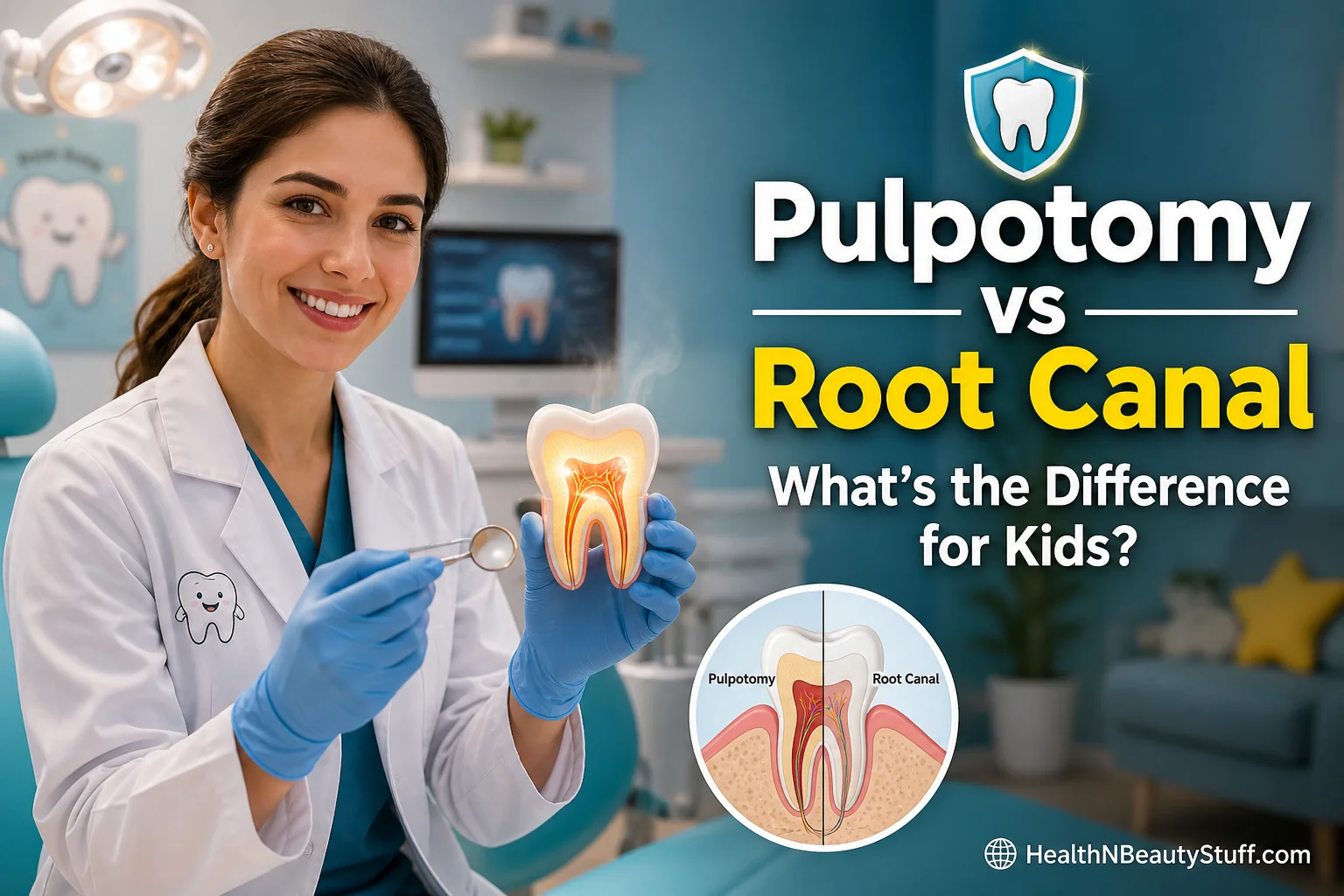
Your child has been crying since yesterday. The tooth that seemed fine last week is now keeping them up at night. You rush to the pediatric dentist, the X-ray goes up on the screen, and the dentist turns to you and says: "This one needs a pulpotomy."
And your stomach drops. Because you've never heard that word before.
Is it a root canal? Is it worse? Is it going to hurt your kid? You nod like you understand, but the moment you step outside, you pull out your phone and start searching.
You're in the right place. This guide breaks down pulpotomy vs root canal in plain English, so you know exactly what's happening in that chair and why.
Quick Verdict
A pulpotomy removes only the infected top part of the pulp. A root canal removes all of the pulp, including the roots. They are not the same procedure, and they are not interchangeable.
Pulpotomy is most often done on baby teeth when the infection is caught early. A full root canal is the standard for permanent teeth with deep or spreading infection. Which one your child needs depends on how far the decay has gone. An X-ray is the only way to know for sure.
At a Glance: Pulpotomy vs Root Canal
| Factor | Pulpotomy | Root Canal |
|---|---|---|
| What's removed | Infected crown pulp only | All pulp: crown + roots |
| When it's used | Infection limited to crown, early stage | Deep infection, permanent teeth |
| Pain level | Mild soreness after | Mild to moderate soreness after |
| Typical cost (US) | $75 - $450 | $400 - $1,500+ |
| Recovery | Soft foods, mild soreness 1-2 days | Soft foods, soreness, follow-up crown |
| Tooth type | Usually baby (primary) teeth | Usually permanent teeth |
What Is a Pulpotomy?
Think of your tooth as a building. The pulp is the soft living tissue inside, running from the top (the crown) down through the roots. When bacteria eat through enough enamel, they can reach that pulp. That's when things start to hurt.
A pulpotomy removes only the infected pulp from the crown (the top part of the tooth). The pulp down in the roots stays in place, as long as it still looks healthy. A medicated material is placed inside to calm the remaining tissue, and then a crown is usually put on top to protect the tooth.
It's sometimes called a "baby root canal" because it's used mostly on primary (baby) teeth. But that nickname is a little misleading. A pulpotomy is much less involved than a full root canal.
The goal is to keep the baby tooth healthy long enough to fall out on its own, so the permanent tooth underneath can grow in correctly.
What Is a Root Canal?
A root canal goes all the way. The dentist removes the infected pulp from both the crown and the root canals, cleans the inside of the tooth thoroughly, and seals everything shut.
On a permanent tooth, this is the standard fix when decay reaches deep into the roots or an abscess has formed. After the root canal, the tooth is typically fitted with a crown to protect it, since the tooth becomes more brittle once the pulp is gone.
Despite its scary reputation, most patients say a modern root canal feels similar to getting a filling. The pain you feel before the procedure is usually worse than the procedure itself.
Root canals save teeth that might otherwise need to be pulled. That matters a lot when we're talking about a permanent tooth you need for the rest of your life.
Pulpotomy vs Root Canal: The Key Differences
The headline difference is simple: how much pulp is removed. But that one difference changes everything about when each procedure is appropriate.
- Pulpotomy: partial removal. Healthy root pulp stays. Used for baby teeth with early infection.
- Root canal: complete removal. No pulp remains. Standard for permanent teeth with deep or spreading infection.
Here's the thing parents often miss: a dentist won't choose between these two based on what you'd prefer. They choose based on what the X-ray shows. If the infection is only in the crown pulp, a pulpotomy works. If it's in the roots too, a pulpotomy won't cut it.
The other key difference is the tooth type. Pulpotomies are almost always done on baby teeth. Root canals are standard for adult permanent teeth.
When Is a Pulpotomy Enough?
A pulpotomy is the right call when several things line up at once:
- The tooth is a baby (primary) tooth
- The infection has reached the pulp in the crown, but has not spread to the roots
- The root pulp still looks healthy on the X-ray
- The baby tooth still has years left before it would naturally fall out
- There is no abscess or signs of spreading infection
If all of those are true, pulling that baby tooth early would actually cause more harm. Baby teeth hold the space that permanent teeth need to grow in correctly. Losing them too soon can cause crowding and alignment issues later.
A pulpotomy keeps the tooth in place. It lets the baby tooth do its job until the permanent tooth is ready. That's the whole point.
When Is a Full Root Canal Needed?
Sometimes the infection has spread too far for a pulpotomy. A full root canal becomes necessary when:
- The tooth is a permanent tooth (the standard treatment regardless of how deep the decay is)
- The infection has spread into the root canals
- There is an abscess (a pus-filled pocket at the root tip)
- The child is in significant pain and the root pulp looks damaged on X-ray
- A baby tooth has an infection that has clearly spread beyond the crown
On a permanent tooth, a root canal is almost always preferable to extraction. Even a tooth with no living pulp can last decades with proper care and a crown on top.
And just so you know: studies are exploring whether pulpotomy might work on certain permanent teeth with deep cavities as an alternative to a full root canal. But for now, the standard recommendation for permanent teeth with pulp involvement remains a full root canal. Your dentist will guide you based on current best practices and what the X-ray shows.
Pulpotomy vs Pulpectomy: One More Distinction
Here's where parents often get confused, because there's a third term floating around: pulpectomy.
A pulpectomy is when all of the pulp is removed from a baby tooth, including the root canals. Think of it as a full root canal, but on a primary tooth. The canals are then filled with a resorbable material, which dissolves naturally as the baby tooth eventually falls out.
So to keep it straight:
- Pulpotomy: remove crown pulp only (baby tooth, early infection)
- Pulpectomy: remove all pulp, roots too (baby tooth, infection has spread to roots)
- Root canal: remove all pulp, clean and seal permanently (permanent tooth)
When a dentist says "root canal for kids," they might mean a pulpotomy or a pulpectomy. The X-ray will determine which one is actually needed.
Cost Comparison: Pulpotomy vs Root Canal
Cost varies by location, practice, and insurance. But here are the verified US ranges to give you a realistic picture.
- Pulpotomy: typically $75 to $300 (with some pediatric practices in urban areas ranging up to $450)
- Pulpectomy (baby tooth full pulp removal): approximately $400 to $700
- Root canal (adult permanent tooth): commonly $700 to $1,500 or more for molars, depending on the tooth and provider
A crown is usually added on top of any of these procedures, which adds its own cost. For baby teeth, a stainless steel crown is common and typically less expensive than the ceramic crowns used on adult teeth.
Most dental insurance plans cover a portion of these treatments, especially for children. Always call your insurance provider before the appointment to understand your out-of-pocket costs.
It Depends: How to Know Which Your Child Needs
Here's the honest answer: you cannot tell from the outside which procedure is needed. Neither can the dentist without an X-ray.
That said, these signs can give you a clue about what's happening before you walk into the office:
- Mild, recent toothache that started with sweets or cold: may be early pulp involvement
- Throbbing pain that doesn't stop even without a trigger: could mean deeper infection
- Swollen gums or visible bump near the tooth: possible abscess, may need more than a pulpotomy
- Tooth sensitive to heat more than cold: often a sign the pulp is more seriously affected
- No pain at all (tooth looks dark or damaged): infection may have killed the pulp; X-ray needed
Your pediatric dentist will take an X-ray to see exactly how far the decay has spread. The X-ray is the decision-maker. No amount of symptom-checking at home can replace it.
Once you have the X-ray results, don't be afraid to ask questions. You're the parent. You get to understand what's happening before you say yes to any procedure.
Final Verdict
If your child's dentist recommends a pulpotomy, it's actually good news compared to the alternative. It means the infection was caught before it spread all the way to the roots. A pulpotomy is a smaller, less invasive procedure that keeps the baby tooth doing its job.
If a full root canal is recommended, whether for a permanent tooth or a baby tooth with deeper infection, try not to panic. Root canals have a much worse reputation than they deserve. They save teeth. They stop pain. And they're done under local anesthesia, which means your child (or you) shouldn't feel the procedure itself.
Here are three questions to ask your dentist before either procedure:
- "Has the infection reached the roots, or is it still in the crown pulp?"
- "Will a crown be needed after, and what type would you recommend?"
- "How long should this tooth last, and what happens if we wait?"
Those three questions will tell you everything you need to know. You've got this.