New articles every week — Expert-backed health & beauty tips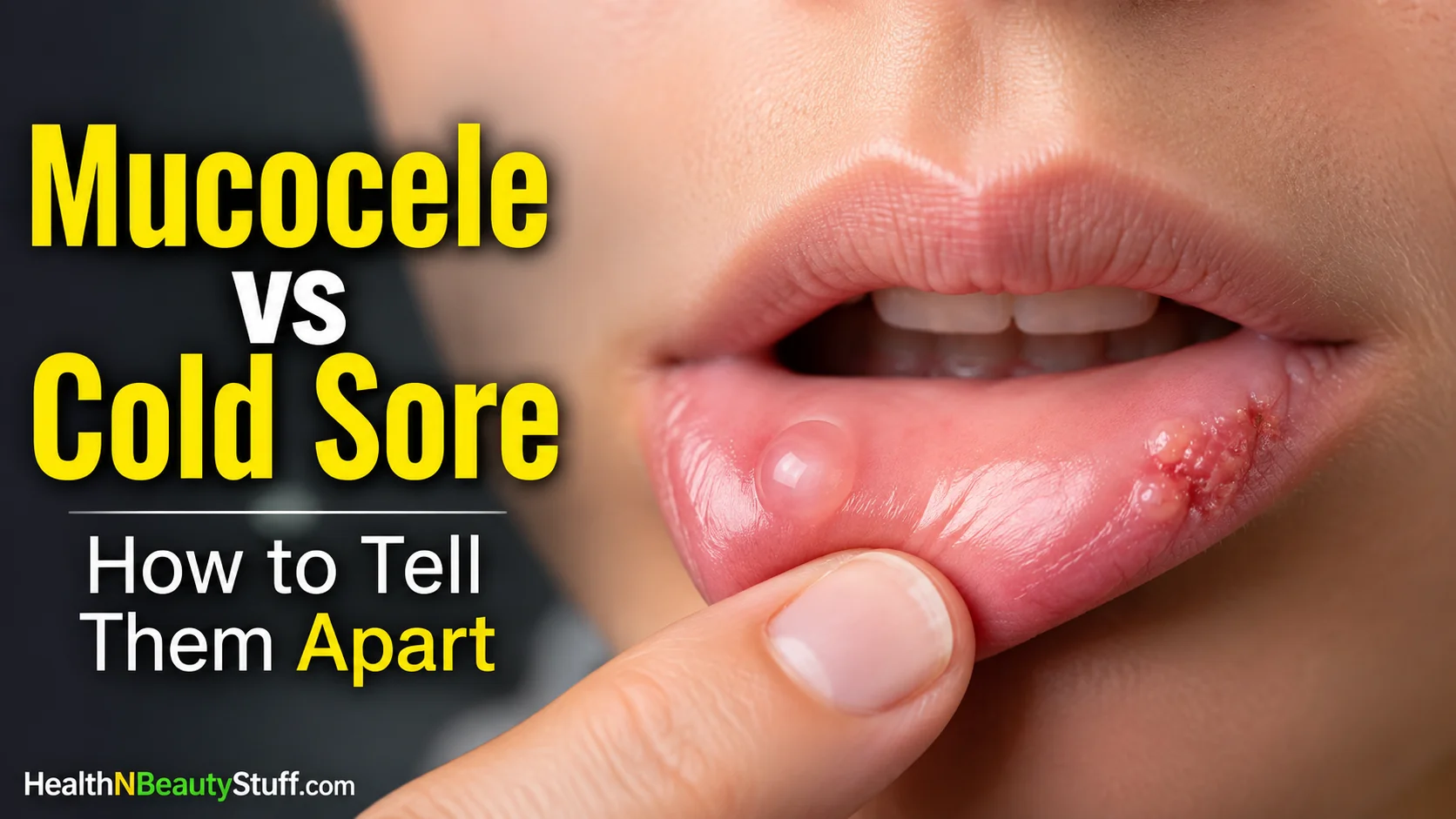
You’re lying in bed, and your tongue keeps finding a small bump inside your lower lip. You think cold sore. But it does not tingle, hurt, or crust. Several days pass, and it still feels like a tiny water balloon.
That pattern is not the usual cold sore story. A painless bump inside the lower lip may be a mucocele, which forms when a small salivary gland is blocked or damaged.
The difference matters. You may be worried about herpes, cancer, kissing your partner, or an expensive dental visit. This guide cannot diagnose the bump, but it can help you judge what fits and what to do next.
Quick Verdict: A smooth, painless bump inside the lower lip that does not crust is more likely a mucocele. A tingling or painful cluster of blisters on the outer lip that later crusts is more likely a cold sore. If the bump is hard, growing, or not healing, have a dentist or doctor examine it.
Mucocele vs cold sore: The quick verdict
Location, sensation, and change over time offer the best clues. No single clue proves the diagnosis, but the overall pattern is often clear.
- Think mucocele first when the bump is inside the lower lip, smooth, round, and painless.
- Think cold sore first when tingling or burning leads to tiny blisters around the outer lip.
- Mucocele fluid may drain and return. It usually does not form a dry crust.
- Cold sore blisters tend to break, ooze, crust, and heal.
- A mucocele is not contagious. A cold sore is contagious.
If your bump has been painless, stable, and inside the lip, cold sore cream may be aimed at the wrong problem.
What is a mucocele?
A mucocele is a harmless, fluid-filled swelling caused by a damaged or blocked salivary gland. Saliva collects under the mouth’s lining instead of draining normally.
Minor salivary glands sit beneath the inner lips and other parts of the mouth. Biting the lip, rubbing it against a tooth, or another small injury can damage one.
A typical oral mucocele may be:
- A single, smooth, dome-shaped bump
- Clear, pink, white, or slightly blue
- Soft or springy when touched
- Located inside the lower lip
- Usually painless
It may feel like a small grape under thin skin. If you keep catching it between your teeth, it can become red or sore. That tenderness follows irritation. It is not the burning warning that often comes before a cold sore.
A mucocele is not an infection or an STD. You cannot spread it by kissing, sharing food, or touching it.
What is a cold sore?
A cold sore is a group of fluid-filled blisters caused most often by HSV-1. It is also called a fever blister or herpes labialis.
Cold sores usually form on or around the lips. Many begin with a warning stage before anything is visible.
- Tingling around one spot
- Burning or itching
- Tender or tight-feeling skin
- Small blisters on red skin
- Oozing followed by crusting
Most cold sores heal in about two to three weeks without leaving a scar. They can return, sometimes in a familiar spot.
Stress, illness, colds, and sun exposure may trigger another outbreak. Recurrence does not mean someone has recently acquired HSV-1.
HSV-1 is common and is not a reason for shame. Many people acquire it through ordinary nonsexual contact, sometimes during childhood.
Mucocele vs cold sore: At-a-glance comparison
A mucocele is an inner-lip salivary bump, while a cold sore is usually an outer-lip viral blister. Here is how their features compare.
| Feature | Mucocele | Cold sore |
|---|---|---|
| Location | Usually inside the lower lip | Usually on the outer lip or lip border |
| Cause | Blocked or damaged salivary gland | Most often HSV-1 |
| Appearance | One smooth, fluid-filled dome | A cluster of tiny blisters on red skin |
| Sensation | Usually painless | Tingling, itching, burning, or pain |
| Surface | Normally stays smooth rather than crusting | Blisters open, ooze, and form a crust |
| Contagious | Not contagious | Contagious |
| Course | May persist, drain, refill, or return | Usually heals in about two to three weeks |
| Treatment | Observation, or removal if it persists or recurs | Cold sore products or prescription antiviral medication |
Location is the number one clue: Inside the lip vs on the lip
A bump on the wet inner lower lip points toward a mucocele. Blisters on the dry outer lip or its border point more toward a cold sore.
This location difference reflects where each problem begins. Minor salivary glands sit just under the mouth’s moist inner lining. When one is damaged, saliva can pool there.
Cold sores develop where HSV-1 becomes active in nearby nerve endings. They often appear around the outer lips. They may also affect skin near the nose or chin.
There are exceptions. A chewed mucocele can look red and irritated. A clinician may also need to distinguish an unusual inner-mouth blister from other conditions.
Still unsure? Look in a mirror and gently roll the lip outward. Wet inner surface suggests mucocele. Dry outer skin plus grouped blisters suggests a cold sore.
Pain and sensation: Tingling says herpes, slow bulge says mucocele
Tingling or burning before a blister strongly favors a cold sore. Mucoceles often appear without warning and feel more annoying than painful.
The cold sore warning stage may feel like a hot, itchy pinprick. Hours later, small blisters may rise in that same area.
A mucocele feels different. You may notice it only because your tongue keeps brushing a smooth bulge. It can feel like a water blister beneath the inner lip.
Can a mucocele hurt? Yes, if you bite or rub it. It may swell, turn red, or feel tender afterward. But pain caused by repeated biting is not the same as an early viral tingle.
Timeline: Cold sores change fast, mucoceles linger
Cold sores move through visible stages, while mucoceles may remain smooth or repeatedly refill. Watching the bump can reveal more than one photograph.
A common cold sore pattern is:
- Tingling, itching, or burning
- A cluster of tiny blisters
- Open or oozing areas
- A dry crust or scab
- Gradual healing
A mucocele may stay dome-shaped without crusting. It might rupture during eating, flatten, and later fill again because the damaged gland remains underneath.
A painless bump that stays much the same is less typical of a cold sore. If it persists or returns, arrange an oral examination rather than repeatedly treating it yourself.
Contagion: Can I kiss someone?
Cold sores are contagious, but mucoceles are not. This may be the most important practical difference for your partner and family.
Cold sores can spread through direct contact. During an outbreak, avoid:
- Kissing
- Oral sex
- Sharing drinks, utensils, or lip products
- Touching the sore and then touching another person
Wash your hands if you touch the area while applying treatment. Avoid touching your eyes afterward.
A mucocele contains saliva rather than cold sore virus. It cannot give another person herpes, and a child with a mucocele cannot spread the bump to classmates.
Can you pop a mucocele or cold sore? No, here’s why
Do not pop either type of lip bump. Popping increases irritation and still does not address the underlying cause.
Cold sore fluid can contain HSV-1. Breaking the blisters can spread fluid to nearby skin or other people. Picking may also increase pain and expose damaged skin to another infection.
A mucocele is not a pimple. Puncturing it may release fluid, but the injured salivary gland remains. The bump can fill again.
Home cutting or draining can also cause bleeding and infection. Leave the surface intact, especially when you are not sure what the bump is.
Treatment: Cold sore antivirals vs mucocele removal
Cold sores need viral outbreak care, while mucoceles need protection from trauma or dental treatment. Using the wrong product is unlikely to solve the problem.
For a cold sore
- Start an over-the-counter cold sore product as directed, ideally during early tingling.
- Keep the area clean and avoid picking it.
- Avoid close contact while the sore is active.
- Ask a doctor about oral antiviral medication for severe or frequent outbreaks.
- Discuss suppressive treatment if outbreaks keep disrupting your life.
Topical products are easy to obtain and may suit mild outbreaks. Their benefit depends partly on starting early. Antiviral medication manages outbreaks, but it does not treat a blocked salivary gland.
For a mucocele
- Stop biting, sucking, or rubbing the lip.
- Watch a small, uncomplicated bump for change.
- See a dentist if it persists, grows, or keeps returning.
- Ask whether an oral surgeon should evaluate it.
- Request a written cost estimate before any planned procedure.
Some mucoceles resolve on their own. Persistent or recurring ones may be removed. A clinician may address the affected salivary tissue to lower the chance that the bump returns.
What should you expect? The exact procedure and recovery depend on the bump’s size, depth, and location. Ask about anesthesia, stitches, aftercare, and recurrence before agreeing to treatment.
Mucocele removal costs vary by provider, location, insurance, and how complex the lesion is. The dental office can explain coverage and provide a written estimate.
Mucocele vs cold sore vs canker sore: Why the three-way comparison matters
A mucocele is a bump, a canker sore is an ulcer, and a cold sore is usually a blister cluster. Mixing them up can lead to unnecessary worry or ineffective treatment.
Mucocele
- Usually inside the lower lip
- Smooth and fluid-filled
- Usually painless
- Not contagious
Canker sore
- Forms inside the lips, cheeks, or under the tongue
- Looks like a shallow open sore with a pale center
- Often painful, especially with acidic foods
- Not contagious
Cold sore
- Usually forms on the outer lip or lip border
- Looks like grouped, fluid-filled blisters
- Often tingles, burns, and later crusts
- Contagious
If your tongue feels a smooth ball, think mucocele. If you see a painful crater, think canker sore. If grouped outer-lip blisters crust over, think cold sore.
When it’s neither: Red flags that need a professional look
Do not force an unclear mouth bump into one of these two labels. Many conditions can affect the lips and mouth, and some need prompt evaluation.
Arrange an examination if you notice:
- A hard or fixed lump
- Steady growth
- A sore that has not healed after two weeks
- An irregular red or white patch that does not rub off
- Numbness in the lip or chin
- Bleeding without a clear injury
- A lesion that looks unlike both a mucocele and a cold sore
- Six or more cold sore outbreaks per year
A persistent oral lesion is not automatically cancer. Most bumps have less serious causes. Still, only an in-person examination can rule out other conditions.
When to see a dentist or doctor
Choose a dentist for a persistent inner-mouth bump and a doctor for severe or frequent cold sores. Either can guide you if the diagnosis remains uncertain.
See a dentist or oral surgeon when:
- The suspected mucocele lasts more than one to two weeks
- It repeatedly drains and returns
- It is growing
- It interferes with eating or speaking
- You cannot stop biting it
- You want to discuss removal
See a doctor when:
- Cold sore outbreaks are frequent or severe
- The blisters are spreading
- The sore is not healing within two weeks
- You have a weakened immune system
- You need prescription antiviral medication
If you are unsure, a dentist is often a useful first stop for an inner-lip bump. Dentists routinely examine oral tissue and salivary glands.
Mucocele vs cold sore: Location, pain, and time decide
Most cases can be separated by where the bump sits, how it feels, and how it changes. Treat these clues as guidance, not a home diagnosis.
When it is probably a mucocele
- Painless bump inside the lower lip
- Single, smooth, fluid-filled dome
- No tingling before it appeared
- No crusting
- It drains and later refills
When it is probably a cold sore
- Tingling blister cluster on the outer lip
- Burning, itching, or pain
- Several tiny blisters rather than one smooth bump
- Oozing followed by crusting
- Past outbreaks with a similar pattern
When it could be either or neither
- The location and appearance do not match
- The bump is hard, fixed, or steadily growing
- It remains open or does not heal
- There is unexplained bleeding or numbness
- You simply cannot tell what you are seeing
When the signs conflict, skip the guessing. A short clinical examination is safer than repeated home treatment.