New articles every week — Expert-backed health & beauty tips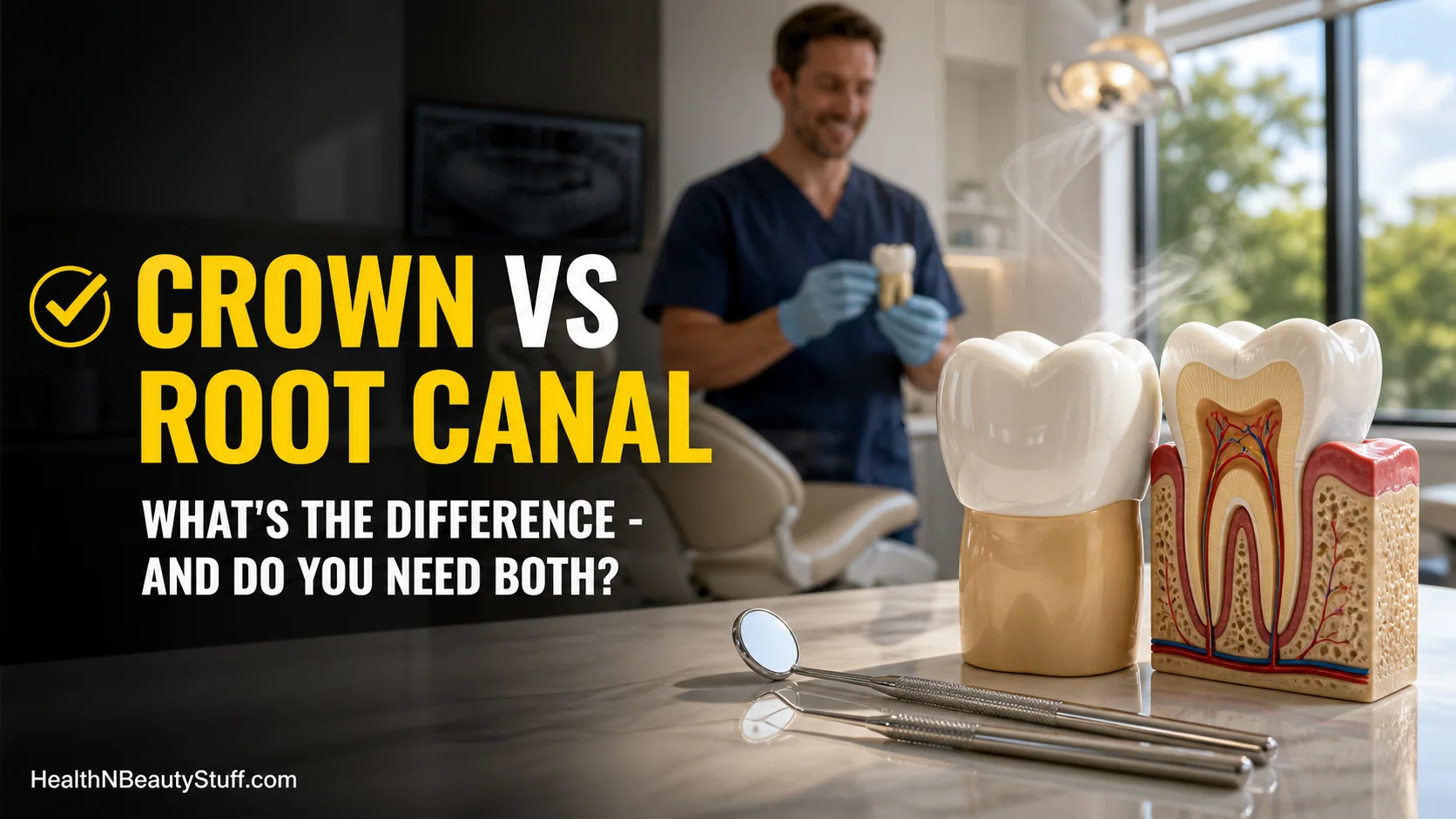
Is it better to get a crown or a root canal? The truth is, this question is a trick. You usually are not choosing between the two.
Quick Verdict
A root canal saves an infected tooth from the inside. A crown protects a weakened tooth from the outside.
If the pulp is infected, a crown alone won't fix it. You need a root canal first - and often a crown afterward. If the tooth is merely cracked with a healthy nerve, a crown alone is enough.
Most people assume "crown vs root canal" means picking one procedure instead of the other. That is a false choice. A root canal treats the inside of your tooth (an infection). A crown protects the outside (a weakened shell). They fix different problems, and more often than not, they work together.
If your tooth is infected, the answer is almost never "just get a crown." And if your tooth is cracked but the nerve is healthy, you may not need a root canal at all. The right answer depends on what is actually wrong inside your mouth.
At-a-Glance Comparison
What Is the Difference Between a Root Canal and a Crown?
A root canal and a crown treat completely different parts of the tooth. That is the simplest way to understand this comparison.
A root canal works on the inside. Your tooth has a soft inner chamber called the pulp, which contains nerves and blood vessels. When bacteria reach that chamber through deep decay or a crack, the pulp becomes infected. A root canal removes that infected tissue, cleans the canals, and seals the tooth. According to the Mayo Clinic, this saves a badly damaged tooth from extraction.
A dental crown works on the outside. It is a custom-made cap bonded over the visible part of your tooth to restore its shape, strength, and appearance. Crowns are used when a tooth is cracked, severely worn, or has lost so much structure to decay or large fillings that it cannot function safely on its own.
One treats infection. The other treats structural damage. They are not competing options; they are complementary tools.
Do I Need a Root Canal or a Crown? (Symptom Checker)
The answer depends entirely on your symptoms and what your dentist finds on X-ray. Here is a practical guide.
Signs you likely need a root canal:
- Throbbing tooth pain that comes on by itself, with no obvious trigger
- Sharp pain when biting down that lingers for more than a few seconds
- Sensitivity to heat that stays painful long after the heat is removed
- Swollen, tender gums near one specific tooth
- A small pimple-like bump on the gum (a dental abscess)
- Tooth that has darkened or changed color
Signs you likely need a crown (but not a root canal):
- A cracked or chipped tooth that is sensitive but not throbbing
- An old large filling that is failing or cracking the surrounding tooth
- A tooth that has been worn down from grinding
- Sensitivity to cold that fades quickly (under 10 seconds)
- Visible damage but no spontaneous pain
Cold sensitivity that fades fast generally means the nerve is alive and healthy. Lingering heat pain almost always means the nerve is dying. That distinction matters because a dying nerve needs a root canal, not just a crown.
Root Canal vs Crown Cost: What Will You Pay?
Cost is one of the biggest drivers of this decision. Here is what the verified numbers look like without insurance.
Root canal cost by tooth type (source: CareCredit via GoodRx):
- Front teeth (incisors/canines): $776 to $1,911
- Bicuspids (premolars): $757 to $1,798
- Molars: $1,030 to $2,471
- National average: approximately $1,200
Molars cost more because they have multiple canals to clean. Also note: an endodontist (root canal specialist) charges up to 50% more than a general dentist for the same procedure, according to CareCredit.
Dental crown cost by material (source: GoodRx):
- Porcelain-fused-to-metal (PFM): $800 to $2,000
- All-ceramic or porcelain: $1,000 to $2,500
- Zirconia: $1,000 to $2,500
- E-max: $1,200 to $2,500
- Gold: $900 to $2,500
- Average: approximately $1,300
When you need both, expect to pay roughly $3,000 out of pocket before insurance (ADA News). With dental insurance, that figure typically drops by about half. Always ask your provider for a pre-treatment estimate before committing.
Same-day crowns (CEREC) may cost a little more upfront but save you a second visit and a temporary crown phase.
Which Hurts More: Root Canal or Crown?
Root canals have a terrifying reputation. The reality does not match the myth.
Both procedures use local anesthesia, which numbs the tooth completely before anything begins. Most patients report feeling pressure, not pain, during the actual treatment. The root canal got its bad reputation in the era before modern anesthesia.
Here is an honest comparison of what to expect after each procedure:
After a root canal: You will likely have soreness and tenderness for two to four days. Over-the-counter pain relievers handle this for most people. The discomfort comes from the tissue around the tooth reacting to the work done nearby.
After a crown placement: You may notice sensitivity to hot and cold temperatures for one to two weeks, according to Cleveland Clinic. The gum around the prep site may also be tender for a few days.
So which is worse? Honestly, the root canal tends to produce slightly more post-op tenderness. But here is the key thing to understand: the pain you feel before the root canal, from the infection itself, is almost always far worse than the procedure. The root canal ends that pain. A crown alone would not.
Root Canal Then Crown: Why You Often Need Both
This is the sequence most patients do not expect: you come in for a root canal and leave with plans for a crown, too. Why?
When a root canal removes the infected pulp, it also removes the tooth's blood supply. Without blood flow, the tooth becomes dry and brittle, like a dead branch on a tree. It can still function, but it is far more likely to crack under the pressure of normal chewing.
A crown after root canal acts like a helmet. It distributes biting force evenly across the entire tooth and prevents fractures. According to Mayo Clinic, a root-canal-treated tooth can last a lifetime when it is properly restored with a crown.
The rule of thumb most dentists use:
- Back teeth (molars and premolars) almost always need a crown after root canal. They absorb heavy chewing force.
- Front teeth (incisors) sometimes do not need a crown because they handle much less pressure. A filling or a veneer may be enough.
Do not skip the crown to save money. An uncrowned root canal tooth that fractures vertically may be impossible to save at all.
Pros and Cons
Root Canal
Dental Crown
When It Depends: Edge Cases Worth Knowing
Not every case is straightforward. Here are the situations where the answer shifts.
A crown is enough (no root canal needed): If your tooth has a minor fracture, significant wear, or a failing old filling but the nerve is healthy and the pulp is not infected, a crown alone restores the tooth completely. No root canal required.
A root canal without a crown (front teeth): For front incisors that handle lighter bite forces, some dentists use a filling or composite buildup instead of a crown after root canal treatment. This is less common and depends on how much natural tooth structure remains.
When neither works: If a tooth has a vertical root fracture, or decay has spread below the gumline, neither procedure can save it. In that case, extraction followed by a dental implant becomes the most practical option. An implant costs more upfront ($3,000 to $5,000 per tooth) but often lasts longer than a compromised natural tooth.
The "do nothing" risk: Leaving an infected tooth untreated is never a safe wait. Infection spreads to surrounding bone and neighboring teeth. In rare cases, it spreads further and becomes life-threatening. There is no neutral option when a nerve is infected.
Can a root canal be done through an existing crown? Yes. A dentist or endodontist can drill an access hole through the crown to reach the canals. If the crown is otherwise intact and well-fitted, it can often be preserved after the root canal is completed.
Questions to Ask Your Dentist Before Saying Yes
Before agreeing to any procedure, ask your dentist these specific questions. The answers will clarify exactly what you need and why.
- Is the nerve infected or just irritated? Irritated nerves sometimes heal with less invasive treatment.
- How much natural tooth structure is left? This determines whether a crown is necessary and what type will work.
- Do I need the crown right after the root canal, or can it wait? Timing matters for budgeting.
- What is the total cost, with and without my insurance? Ask for a written pre-treatment estimate.
- Should I see a general dentist or an endodontist for this root canal? Complex cases benefit from specialist care.
- Is extraction plus an implant a realistic alternative? Sometimes it is. Get the full picture.
Final Verdict
Crown vs root canal is a false either/or choice. The real decision tree is simple:
- Is the nerve/pulp infected? You need a root canal. A crown is not a substitute.
- Is the tooth structurally weak but the nerve healthy? A crown alone is enough.
- Both problems present? Root canal first, then a crown. That is the most common outcome.
If you have a deep infection, a crown is not an alternative to a root canal. It is part of saving the tooth. The root canal removes the problem; the crown ensures the solution holds.
The goal in both cases is the same: keeping your natural tooth for as long as possible. Modern dentistry makes that achievable without the level of pain most people fear.