New articles every week — Expert-backed health & beauty tips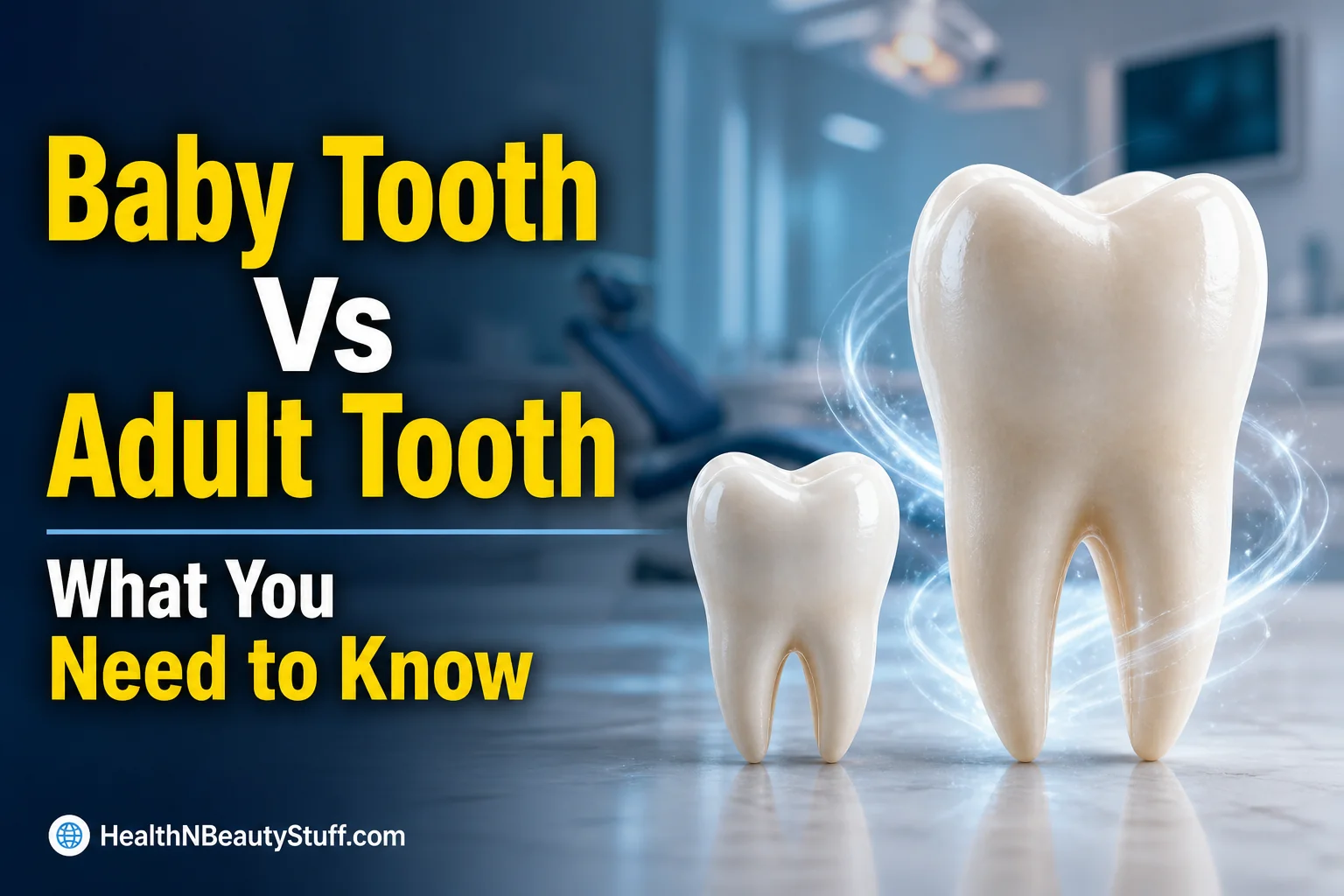
Your child grins after losing a front tooth. Then you spot the replacement. It looks bigger, uneven, and much more yellow. Is that new tooth already stained?
Take a breath. Baby teeth are smaller, whiter, and have thinner enamel than adult teeth. Adult teeth are larger, more yellow, and built to last for decades.
The real concern is not which tooth looks better. It is whether the tooth is arriving on the right timeline. A yellow adult tooth behind a white baby tooth is often normal. Pain, swelling, or a baby tooth that stays firmly in place deserves more attention.
Quick Verdict: Baby teeth and adult teeth are different by design. If an adult tooth appears behind a baby tooth, encourage gentle wiggling. If the baby tooth remains firm after 2 to 3 weeks, contact a dentist. Adults with a retained baby tooth should get it checked, but removal is not always needed.
Baby tooth vs adult tooth: At-a-glance comparison
The easiest differences to spot are color, size, shape, and location. This table can help you identify what you see. It cannot diagnose decay or an eruption problem.
| Feature | Baby tooth | Adult tooth |
|---|---|---|
| Number | 20 primary teeth in a complete set | 32 permanent teeth, including four wisdom teeth |
| Color | Bright white and more opaque | Yellowish or slightly gray and more translucent |
| Size | Smaller to fit a child’s jaw | Larger to fit the growing adult jaw |
| Shape | Rounder crowns and flatter biting edges | More defined edges, grooves, and chewing cusps |
| Enamel | Thinner protective outer layer | Thicker and more mineralized outer layer |
| Roots | Roots shorten as the replacement tooth develops | Long roots stay anchored in the jawbone |
| Lifespan | Temporary, usually shed between ages 6 and 12 | Permanent and intended to last for life |
| Main job | Chewing, speech, and holding space | Chewing, speech, bite support, and appearance |
Color alone should never decide whether a tooth needs treatment. Lighting, plaque, staining, and enamel changes can affect how any tooth looks.
How to tell a baby tooth vs adult tooth at home
Start with color and size, then check the tooth’s location and movement. You do not need special equipment. Use a mirror, clean hands, and good lighting.
Follow this simple check
- Look at the color: Baby teeth often look milky white. Adult teeth may appear cream, yellow, or slightly gray.
- Compare the size: A new permanent front tooth often looks much wider than the baby tooth beside it.
- Check the edge: New adult incisors may have small bumps along the biting edge. These often smooth with normal use.
- Notice the location: A tooth growing behind another tooth may be a permanent tooth taking a different eruption path.
- Test movement gently: A baby tooth near shedding time usually wiggles. A permanent tooth should feel firmly anchored.
- Check the back: First permanent molars appear behind the last baby molars. They do not replace another tooth.
Those back molars often arrive around age 6 or 7. Because no baby tooth falls out first, parents may not realize they are permanent.
Never use force, string, or tools to test a tooth. Stop if touching it causes pain or bleeding.
Why adult teeth look more yellow than baby teeth
Adult teeth look more yellow because their enamel lets more dentin color show through. Enamel is the hard outer shell. Dentin is the warmer yellow layer beneath it.
Baby tooth enamel is more opaque. It blocks more of the dentin’s color, creating that bright white look.
Place a new adult tooth beside a baby tooth, and the contrast can seem dramatic. It may look dirty even after brushing. That can be unsettling, but a naturally yellow permanent tooth is not automatically unhealthy.
Watch for a sudden color change instead. A tooth that becomes gray after a fall may have suffered trauma. White or brown patches can also point to enamel changes or early decay.
Do not use whitening products on a child without dental advice. A dentist can tell normal color apart from staining, injury, or enamel problems.
Baby teeth vs adult teeth: Enamel, decay, and cavity risk
Baby teeth can develop deep cavities faster because their enamel and dentin are thinner. Decay has less material to cross before reaching the pulp.
The pulp is the soft center containing nerves and blood vessels. When decay reaches it, a child may develop pain, temperature sensitivity, swelling, or infection.
Baby teeth still matter, even though they eventually fall out. They help children chew, form words, and save room for permanent teeth.
A decayed baby tooth may still need a filling, crown, or extraction. Waiting for it to fall out can allow pain or infection to worsen.
Ways to lower cavity risk
- Brush twice daily with fluoride toothpaste.
- Use a rice-grain-sized smear for children younger than 3.
- Use a pea-sized amount from ages 3 through 6.
- Help with brushing until the child can clean every surface well.
- Floss wherever neighboring teeth touch.
- Avoid juice, milk, or sweet drinks at bedtime.
- Arrange regular dental checks, starting by the first birthday.
Permanent teeth are stronger, but they are not cavity-proof. Newly erupted molars have deep grooves that trap food. Those teeth need careful brushing from the day they appear.
Baby tooth vs adult tooth eruption timeline
Most children have baby teeth from infancy and a mix of both tooth types from ages 6 to 12. Timing varies, so being several months early or late is not always a problem.
| Age or stage | Typical dental change |
|---|---|
| About 6 months to 3 years | The 20 baby teeth gradually erupt |
| Age 6 to 7 | First permanent molars and front teeth often appear |
| Ages 6 to 12 | Mixed dentition, with baby teeth shedding as adult teeth arrive |
| Ages 12 to 14 | Most children have 28 permanent teeth |
| Teens to early 20s | Up to four wisdom teeth may begin coming through |
Why do baby teeth loosen? The permanent tooth develops below and signals the baby tooth’s root to shorten. This process is called root resorption.
As the root shrinks, the crown loses support and becomes wobbly. Eventually, little or no root remains when the tooth falls out.
A delayed tooth is not always an emergency. Still, ask a dentist if one side erupts while the matching tooth on the other side remains absent for months.
“Shark teeth” in kids: When an adult tooth erupts behind a baby tooth
An adult tooth coming in behind a baby tooth is common and often corrects itself. Dentists sometimes call this pattern “shark teeth” because two rows appear at once.
You may notice a hard white ridge behind the lower front teeth. The baby tooth might wobble, or it may still feel firm. Seeing two rows can look alarming, but it rarely means something has gone badly wrong.
What to do next
- Ask your child to wiggle the baby tooth with a clean tongue or finger.
- Continue normal brushing around both teeth.
- Offer firm foods if chewing feels comfortable.
- Watch whether the baby tooth becomes looser.
- Check whether the adult tooth begins moving forward.
Do not yank a firm baby tooth. Forced removal can cause pain, bleeding, or damage to nearby gum tissue.
If it stays firm for 2 to 3 weeks after the adult tooth appears, arrange a dental check. A dentist can assess crowding, root loss, and the adult tooth’s path.
Sometimes the dentist recommends removing the baby tooth. That creates room for the tongue and normal growth forces to guide the adult tooth forward. Extraction does not automatically mean braces will be needed.
Can adults have baby teeth? What to do if you still have one
Yes, an adult can keep a baby tooth when its permanent replacement is missing or unable to erupt. This is called a retained primary tooth.
Some retained baby teeth remain useful for years. Others loosen, wear down, sink below nearby teeth, or affect the bite.
A dentist may use an exam and X-ray to check:
- Root length and condition
- Bone support around the tooth
- Decay, cracks, or gum disease
- Whether a permanent tooth exists underneath
- Whether that permanent tooth is trapped or impacted
- Bite alignment and available space
- Future orthodontic or cosmetic plans
Do not remove a stable retained baby tooth just because it is a baby tooth. Monitoring may be the most sensible choice when it is healthy and functional.
If it becomes loose, painful, infected, or badly worn, removal may be appropriate. The next step could involve closing the space, moving another tooth, or replacing the missing tooth. That decision needs an individual dental plan.
Still have a baby tooth at 14? It may reflect normal variation, crowding, a missing permanent tooth, or an impacted tooth. A dental evaluation can identify the reason before treatment is considered.
It depends: Should you pull it, let it fall out, or see a dentist?
Let a loose, pain-free baby tooth fall out naturally, but get help for pain, swelling, or delayed shedding. The right choice depends on movement, timing, and whether an adult tooth is present.
Wait and watch if
- The baby tooth is already loose.
- The child is within the usual shedding age.
- There is no pain, swelling, pus, or bad taste.
- The permanent tooth seems to be following a reasonable path.
- The child can eat and brush comfortably.
Schedule a dental visit soon if
- An adult tooth is visible, but the baby tooth stays firm for 2 to 3 weeks.
- A baby tooth remains long after the matching tooth on the other side fell out.
- The child reaches 14 with an unexplained baby tooth.
- An adult’s retained baby tooth becomes loose.
- Crowding makes brushing difficult.
- A tooth changes color after an injury.
Seek urgent dental or medical help if
- There is facial swelling or rapidly increasing gum swelling.
- The child has fever with dental pain or swelling.
- Pus, severe pain, or trouble opening the mouth develops.
- Trauma pushes a tooth out of position.
- Swallowing or breathing becomes difficult.
Do not automatically choose extraction. Removing a baby tooth too early can allow nearby teeth to drift into its space. That may block the permanent tooth or affect alignment.
Sometimes doing nothing, with regular observation, is best. This applies to many loose childhood teeth and some healthy retained baby teeth in adults.
Baby tooth vs adult tooth: the honest answer
Baby teeth and adult teeth are partners, not competing versions of the same tooth. Baby teeth guide chewing, speech, and jaw development while saving space for the permanent set.
Baby teeth are smaller, whiter, temporary, and protected by thinner enamel. Adult teeth are larger, more yellow, and designed to remain for life.
Movement, timing, and symptoms matter more than color. A loose baby tooth with no pain usually needs patience. A firm baby tooth beside an erupting adult tooth deserves a dental check if it does not loosen within 2 to 3 weeks.
Call sooner for pain, infection, swelling, or trauma. When things look odd but feel fine, a routine dental exam can replace worry with a clear plan.
Baby tooth vs adult tooth: FAQ
These common questions can help you decide what to notice and when to seek care.