You wake up one morning, look in the mirror, and wonder: Am I actually fit? Maybe you’ve been working out for months, or maybe you’re just starting your journey.
The scale tells you one thing, but your energy levels tell another. This confusion is more common than you think. I’ve spoken with countless people who thought they were in great shape until they tried simple fitness tests that revealed surprising gaps.
Here’s the truth: weight and fitness are not the same thing. You can be thin and unhealthy, or carry extra weight and still be strong and capable. That’s why learning how to check body fitness matters far more than stepping on a scale.
The good news? You don’t need expensive gym memberships or fancy equipment to find out where you stand. With the right body fitness assessment methods, you can get clear answers right from your living room.
This guide walks you through everything you need to know about fitness testing at home, from simple heart rate checks to advanced body composition methods. By the end, you’ll have a complete picture of your fitness level and a clear path forward.
Why Checking Your Body Fitness Matters
The Difference Between Weight and Fitness
Let me share something that changed how I think about health. A friend of mine lost 30 pounds and felt amazing, but when we did a simple push-up test, she could barely complete five. Another friend gained 15 pounds of muscle and looked “bigger,” yet his resting heart rate dropped to an athletic 52 beats per minute.
This shows why body composition test results matter more than weight alone. Fitness includes your strength, endurance, flexibility, and how efficiently your heart and lungs work. These factors predict your long-term health better than the number on a scale ever could.
5 Benefits of Regular Fitness Assessments
Regular fitness testing at home gives you powerful insights:
- Track real progress beyond what the scale shows
- Identify weak areas before they become injuries
- Stay motivated with concrete numbers to improve
- Adjust your training based on actual data, not guesses
- Catch health risks early like poor cardiovascular function
When to Test: Timing Your Fitness Checks
Timing matters for accurate body fitness assessment results:
– Best time of day: Morning, before eating or exercising
– Frequency: Every 4-6 weeks for tracking progress
– Avoid testing when: You’re sick, sleep-deprived, or stressed
– Consistency is key: Test under similar conditions each time
The 4 Core Components of Body Fitness
Understanding these four pillars helps you know how to check body fitness comprehensively:
Cardiovascular Endurance
This measures how well your heart and lungs deliver oxygen during activity. It’s tested through cardiovascular fitness test methods like the Cooper test (12-minute walk/run) or resting heart rate checks. A lower resting heart rate generally indicates better cardiovascular health.
Muscular Strength & Endurance
This covers your ability to exert force and sustain effort. The push-up test and plank test are excellent muscular endurance test options that require no equipment.
Flexibility & Mobility
Often overlooked, flexibility affects everything from posture to injury prevention. The sit-and-reach test measures hip, low back, and hamstring flexibility.
Body Composition
This refers to your ratio of fat to lean mass. While BMI calculator tools give a rough estimate, methods like BIA scale readings provide more detail about body fat percentage.
Step-by-Step: How to Check Body Fitness at Home
Quick Start: Your 15-Minute Fitness Check
Short on time? Here’s a rapid assessment you can do today:
- Resting heart rate: Check your pulse for 60 seconds upon waking
- Push-ups: Do as many as possible with proper form
- Plank hold: Time how long you can maintain position
- Sit-and-reach: Measure how far you can reach past your toes
- Waist measurement: Compare waist to hip ratio
Record all results and compare to the benchmarks below!
Test 1 – Resting Heart Rate (Aerobic Fitness)
How to measure:
- Check your pulse first thing in the morning, before getting out of bed
- Place two fingers on your wrist or neck
- Count beats for 60 full seconds (or 30 seconds and multiply by 2)
Test 2 – Push-Up Test (Upper Body Strength)
Proper form checklist:
- Hands shoulder-width apart, fingers forward
- Body forms straight line from head to heels
- Lower until elbows reach 90 degrees
- Push back up to full arm extension
- No sagging hips or raised buttocks
Modified versions for beginners: Can’t do a full push-up? Start with:
– Wall push-ups (standing, hands on wall)
– Incline push-ups (hands on elevated surface)
– Knee push-ups (from knees instead of toes)
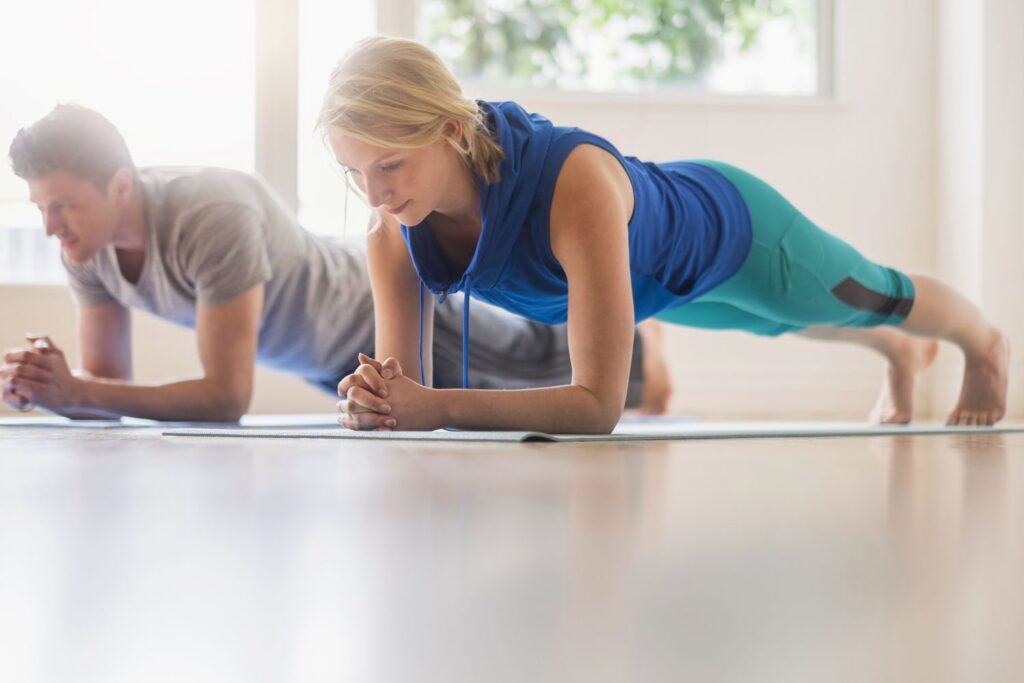
Test 3 – Plank Hold (Core Stability)
Execution guide:
- Start in push-up position, resting on forearms
- Keep body straight from head to heels
- Engage core and glutes throughout
- Breathe steadily, don’t hold your breath
- Time how long you maintain proper form
Common mistakes to avoid:
– Hips sagging toward the floor
– Buttocks raised too high
– Head dropping or craning neck
– Holding breath instead of breathing steadily
Test 4 – Sit-and-Reach (Flexibility)
Equipment needed:
– A box or step (about 12 inches high)
– A ruler or measuring tape
– A partner to help measure (optional)
Measurement technique:
- Sit on floor with legs extended straight
- Place feet flat against the box
- Reach forward with both hands, keeping knees straight
- Hold the reach for 2 seconds
- Measure how far past your toes you can reach
Flexibility norms by age: The sit-and-reach test measures hip, low back, and hamstring flexibility. Generally, reaching 2-4 inches past your toes indicates good flexibility for most adults.
Test 5 – Body Composition Assessment
BMI calculation method:
While limited, BMI calculator tools provide a starting point. A BMI between 18.5-24.9 is classified as normal weight. However, BMI doesn’t distinguish between muscle and fat.
Waist-to-hip ratio guide:
This simple measurement reveals fat distribution patterns:
– Healthy ratio for women: Less than 0.8
– Healthy ratio for men: Less than 0.9
How to measure:
- Measure waist at the narrowest point (usually above belly button)
- Measure hips at the widest point
- Divide waist measurement by hip measurement
BIA scale options: Bioelectrical Impedance Analysis (BIA) uses electrical currents through the body to measure body fat percentage by testing tissue resistance. Smart scales with BIA technology cost $50-$200 and provide convenient home tracking, though accuracy varies compared to professional methods.
Test 6 – 12-Minute Walk/Run (Cardio Capacity)
Cooper Test protocol: Kenneth Cooper developed this cardiovascular fitness test in the 1960s. Here’s how to do it:
- Find a measured track or use a GPS watch
- Warm up for 5 minutes with light walking
- Cover as much distance as possible in 12 minutes
- Walk or run at a sustainable pace
- Record total distance completed
Advanced Fitness Testing Options
VO2 Max Testing: What It Reveals
VO2 Max measures the maximum amount of oxygen your body can use during intense exercise. This cardiorespiratory endurance testing metric is considered the gold standard for aerobic fitness. Important fact: VO2 Max declines about 10% per decade as we age.
Professional testing requires specialized equipment, but some wearable technology now estimates VO2 Max using heart rate and pace data.
Dual-Energy X-Ray Absorptiometry (DXA) is one of the most accurate methods for measuring body composition. However, for regular tracking, consistent use of the same home method often matters more than absolute accuracy.
Wearable Technology Accuracy in 2026
Modern fitness trackers have improved significantly. Apple Watch devices are generally accurate when measuring heart rate and step counts. However, body fat estimates from wearables should be viewed as trends rather than precise measurements.
Interpreting Your Fitness Test Results
Creating Your Fitness Baseline
Your first body fitness assessment establishes a baseline. Don’t worry if scores seem low—this is your starting point, not your final destination. Record all results in a dedicated notebook or spreadsheet.
Age and Gender Comparison Charts
Use the benchmarks provided throughout this guide to compare your results. Remember, these are general guidelines. Individual factors like genetics, training history, and health conditions affect performance.
Red Flags That Need Medical Attention
Consult a healthcare provider before fitness testing at home if you experience:
- Chest pain or pressure during activity
- Dizziness or fainting
- Irregular heartbeat
- Severe shortness of breath
- Joint pain that limits movement
Tracking Progress: Your Fitness Journey
How Often to Re-Test (Recommended Frequency)
For meaningful fitness testing at home without overtraining:
– Beginners: Test every 6-8 weeks
– Intermediate: Test every 4-6 weeks
– Advanced: Test every 3-4 weeks
– Resting heart rate: Check weekly (takes 1 minute)
Free Downloadable Tracking Template
Create a simple spreadsheet with these columns:
– Test date
– Resting heart rate
– Push-up count
– Plank time (seconds)
– Sit-and-reach distance
– Waist-to-hip ratio
– Notes (energy levels, sleep quality, etc.)
When to Adjust Your Training Program
Adjust your approach if you notice:
– No improvement after 8-12 weeks
– Declining performance in multiple areas
– Persistent fatigue or soreness
– Loss of motivation
Sometimes less is more. Recovery is when your body actually gets stronger.
Safety First: Who Should Get Medical Clearance
Pre-Existing Conditions to Consider
Get medical clearance before fitness testing at home if you have:
– Heart conditions or high blood pressure
– Diabetes
– Joint problems or recent injuries
– Respiratory conditions like asthma
– Are pregnant or recently gave birth
Warning Signs During Testing
Stop immediately if you experience:
– Chest pain or tightness
– Severe dizziness
– Nausea
– Irregular heartbeat
– Pain (not to be confused with normal muscle fatigue)
TheSpoonAthletic Smart Fitness Checking Techniques
Technology-Enhanced Assessments
In 2026, you can leverage technology for more accurate body fitness assessment:
– Heart rate monitors: Chest straps provide most accurate readings
– GPS watches: Track distance for Cooper test precisely
– Smartphone apps: Many offer guided fitness testing protocols
– Video analysis: Record your form to check for mistakes
AI-Powered Fitness Tracking (2026 Trends)
Artificial intelligence now helps interpret fitness testing at home results. Some apps can:
– Predict injury risk based on movement patterns
– Suggest personalized workout adjustments
– Track recovery metrics like heart rate variability
– Compare your progress to similar users
Building Sustainable Fitness Habits
Here’s what I’ve learned working with hundreds of clients: consistency beats intensity every time. Instead of dramatic overhauls, focus on:
- Testing at the same time each month
- Celebrating small improvements
- Adjusting goals based on actual data
- Building rest into your routine
Next Steps: From Assessment to Action
Creating Your Personalized Fitness Plan
Use your body fitness assessment results to identify priorities:
– Low cardiovascular scores? Add 2-3 cardio sessions weekly
– Weak upper body? Include push-up progressions 2x per week
– Poor flexibility? Dedicate 10 minutes daily to stretching
– High body fat percentage? Review nutrition alongside training
When to Work with a Professional Trainer
Consider professional guidance if you:
– Have specific performance goals (competition, sport)
– Need help with proper form and technique
– Want accountability and structured programming
– Have health conditions requiring supervision
Resources for Continued Learning
Expand your how to check body fitness knowledge through:
– ACSM (American College of Sports Medicine) guidelines
– Peer-reviewed research on testing validity
– Certified trainer certifications for deeper understanding
– Community fitness groups for motivation and support
Your Fitness Journey Starts Now
Learning how to check body fitness thespoonathletic style isn’t about perfection—it’s about progress. Every test you complete gives you valuable data to work with. Remember, the fittest people aren’t those who never struggle; they’re the ones who keep showing up, tracking their journey, and making small improvements over time.
Start with just one test today. Maybe it’s checking your resting heart rate when you wake up tomorrow. Or perhaps you’ll do a quick push-up test during your lunch break. Whatever you choose, you’re taking the first step toward understanding your body better.